Quantcast

Tuesday, June 16, 2020

On Teaching Lovecraft in the Age of George Floyd (Plus a Reading List)

Hi! I've been working on this post since the beginning of June, but due to my summer-haze work pace and accidentally leaving my laptop in Iowa for a week, I'm only finally getting around to publishing this today. Even if the heat of the protests is behind us, I still want to throw my two cents in the ring here, for whatever it's worth. This is an issue that needs sustained energy, and I'm only just learning how to speak up. Anyway, here we go.

I'd planned to write about this particular lesson from my magic course at some point, but the way I will write about it has now changed thanks to everything that has happened in the past weeks. I'm pretty sure the vast majority of people reading my posts are white, and so I write this for a white audience. I've decided it's important to share my opinion, my voice, my stance, for my white family and friends to know. This is a conversation I want us to be having.

For my magic and language course this past semester, I included on the syllabus a short story by H.P Lovecraft, "The Call of Cthulhu." I chose it because there is both an "unpronouncable" and "unreadable" spoken and written language that play a major role in developing the sense of horror around the great destructive elder Gods ("Cthulhu" being one of them) that form the basis of Lovecraft's influential mythos.

But I was worried about including Lovecraft on the syllable because the man was an outspoken, well documented, agreed with Hitler, named his cat the n-word, disgusting bigot and racist. I was aware of controversies surrounding his racism, and I worried that including him on the syllabus would make it seem like I was giving Lovecraft a platform, or endorsing him as a person "worthy" of canonized status. I finally decided that there was enough value in the contribution the story added to our overall class theme that I wanted to keep it on the syllabus, and the best way to handle the controversy would be to just have an open class discussion about it.

I dedicated two class sessions to discussing Lovecraft. The first class session we kept very focused primarily on the language use in the story, and it was an interesting discussion that worked well for the course. For the next class period, however, I had the students read this article, and then when they showed up to class, I asked them to write for five minutes about what racism they noticed in the story, and what value we should place on this work knowing the views of the author, and whether I should have a place for Lovecraft on the syllabus. For context, my class had 18 students in it, only one of whom was Black, and she mostly refrained from joining in the conversation (absolutely her right), so this was generally white students talking to other white students.

And their answers provided some interesting commentary on how white people in general respond to racism. I had some students who read the whole story and did not notice any form of racism at all. It was a story about monsters under the ocean being awoken to potentially destroy the earth, nothing remotely about racism. Then I had other students who had been so angered and appalled by the racism inherent in the very details of the story that they could barely stomach finishing. It was quite the spectrum.

But I think this is the way racism works for us, as white people. Some of us may go about our lives and not "see" it. We're just living our lives, dealing with our own conflicts, no racism here! That is white privilege. It takes some training, some education, but once someone begins to point out the racism, you can see how it is there, so woven into the fabric of our society that it might be unnoticeable to you, the white protagonist, but it is there, pervasive, everywhere. It is on every page, in almost every line. And once we began examining the racism in the story, it was very hard not to see. In fact, it became clear to us as a class that Lovecraft's story wasn't about fictional alien monsters at all, but actually about racism.

Lovecraft's brand of horror operates on the scariness of the unknown. What is so terrifying about his giant elder gods is that they are presumably beyond human comprehension, so unfathomable that to even try to grasp at their existence or purpose leads men to go insane. They are the definition of the "other." And what Lovecraft tries to evoke through the way he spins his narrative is to build that sense of the unknown, the unknowable. The language that these gods use to communicate with man is barely able to translate into recognizable sound. Lovecraft chose the name "Cthulhu" because it was supposed to look and sound unpronounceable. It was supposed to feel unknowable, and therefore terrifying. Lovecraft explores a type of fear of the unknowable that assumes what is unknown is going to destroy the world as he knew it.

If you read the story closely, you can clearly see this is how Lovecraft felt about other races as well. He seemed to find them unfathomable, so different, so "other," that it was impossible to understand them, and that was horrifying to him. Or perhaps, in the deepest, most unexplored recesses of his psyche, Lovecraft knew that to come to know or understand other races would be the destruction of his world, would be the destruction of white (male) dominance, and he found that too uncomfortable to countenance.

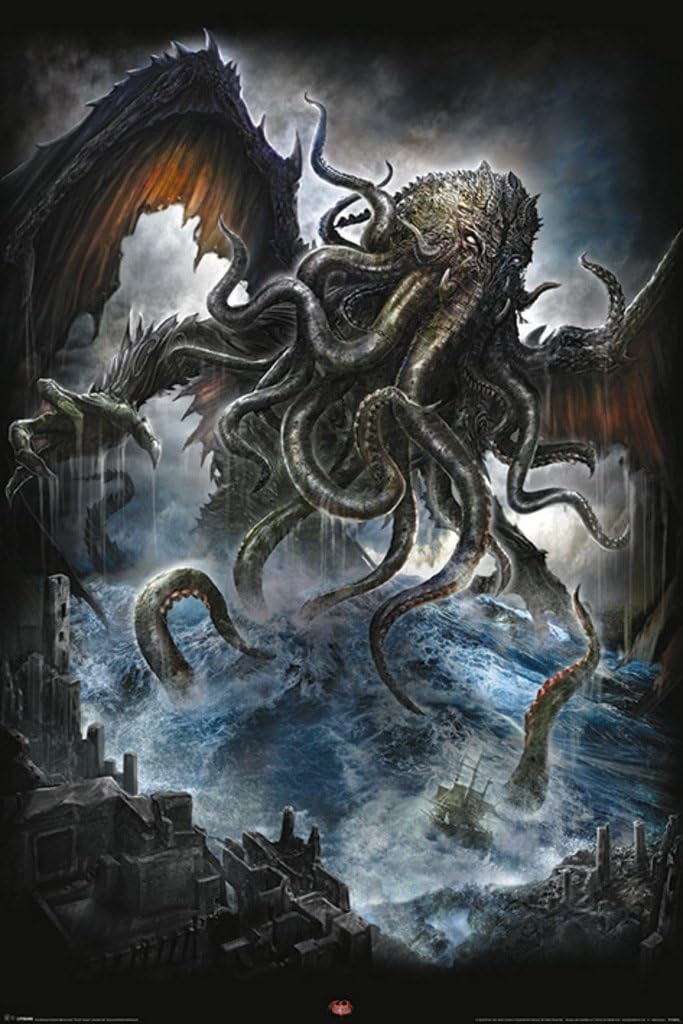
But what we spent most of our class time discussing is how in the very act of writing a story based on the fear of the unknown, Lovecraft undermined his intention. In trying to create a name that was unpronounceable, Lovecraft created a name that people have standardized pronunciation for through the decades and we now say without hesitation (see here, although check the comments to see just how upset everyone is that we pronounce this word at all). Even while declaring the monster indescribable, Lovecraft nevertheless included enough description that readers (and artists) are still able to guess at a fairly uniform image of it.
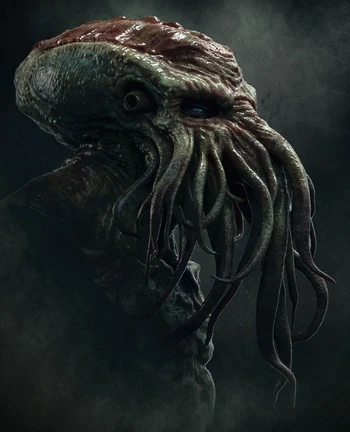
https://lovecraft.fandom.com/wiki/Cthulhu

https://www.reddit.com/r/Lovecraft/comments/blw0jl/cthulhu_by_andr%C3%A9e_wallin/

https://www.amazon.com/Pyramid-America-Spiral-Cthulhu-Rising/dp/B07CS9PD6Y

Lovecraft opens his story with this paragraph: "The most merciful thing in the world, I think, is the inability of the human mind to correlate all its contents. We live on a placid isle of ignorance in the midst of black seas of infinity, and it was not meant that we should voyage far. The sciences, each straining in its own direction, have hitherto harmed us little; but some day the piecing together of dissociated knowledge will open up such terrifying vistas of reality, and of our frightful position therein, that we shall either go mad from the revelation or flee from the deadly light into the peace and safety of a new dark age."

Then he goes on from there to tell an entire story that does nothing but piece together bits of dissociated knowledge to reveal a sensible whole story of what are supposed to be terrifying monsters bent on destroying earth. Yet by the end of the story, we are no more driven mad by horror than we are by curiosity, and there is no impulse to flee from the deadly light.

What I proposed to my class is that Lovecraft had it all wrong when he assumed we should be afraid of the unknown. While we could debate for endless ages about whether powerful alien gods are or are not actually unknowable, what we can assume (both from the story and from his real life) is that Lovecraft was deeply afraid of other races because he did not know them, did not understand them.  While it is very true that knowing another race and acknowledging that race's humanity may be difficult, and may destroy our own worldview, it is far from the most terrifying thing. The most terrifying thing may very well be our own selves, our own ability to de-humanize others.

When we keep ourselves in ignorance, when we refuse to learn about the "other," when we refuse to acknowledge the reality, the humanity, the valid experiences and emotions, of other races, that is when we become the monsters.

But we are capable of learning. We are capable of understanding. We are capable of reaching across "black seas of infinity" and piecing together dissociated pieces of knowledge to open up vistas of reality that may be terrifying, but not because they reveal monsters that will drive us mad, but because they reveal other humans we have treated wrongly. Guilt may destroy our world view, but it will not destroy our sanity. We must trust that coming to face the unknown, coming to learn about the "other," is the only way to avoid the new dark age Lovecraft touts as a desirable condition for humanity. His racism would have us wallow in darkness because it is safe and peaceful (for us, the white dominant race). The light might be terrifying, but I will always choose the light over the dark.

Light is knowable. Light is knowledge.

I want to be clear here. I am not saying that I will ever be able to truly understand what it feels like to be Black in America today. I am not saying I will ever be able to empathize completely, or really "know." What I am saying is that humans may be the only species capable of imagining what it is like to be someone else. We are a species that is capable of greater understanding. We may not be able to understand everything yet, and it may take many years of long, hard work to get there, but the work of seeking more knowledge, seeking more understanding, seeking to really listen, listen, listen, and validate the humanity and reality of the "other", will lead us to a place out of darkness. Maybe it is scary, and uncomfortable, and chaotic here, facing these unknowns. But we must always choose the light over the darkness.

I actually just finished reading Malcom Gladwell's Talking to Strangers (which, PS tangent, offers a super interesting look into the history of police work and one aspect of why police work the way they do, and how it leads to tragedy) in which he says something along the lines of how we are terrible at knowing when we are being lied to, and true communication may be almost impossible because we have such a hard time truly understanding each other. I take the more positive view that we may be terrible now, but understanding "others" is not impossible. Just difficult. It is the work of  a lifetime, perhaps many lifetimes. Just because it is hard does not mean we should not try.

My class finally decided that it was probably fine for me to leave Lovecraft on the syllabus for the single reason that it allowed that conversation to happen (I even had a few students tell me that class discussion was the single most impactful class they had all semester). It was worth reading the words of a racist so that we could point out to each other what the racism was and why it was wrong. We can read Lovecraft to learn that he had it all wrong.

I've had many conversations with people about my class over the past few months, because I love sharing about this course, but some of the most disappointing conversations have been with white men who, when they ask what books I'm teaching and I mention Lovecraft, have gushed enthusiastically, "I love Lovecraft!" And I wait for the "but..." that never comes. To all those white men I was too afraid to confront in the moment, Lovecraft needs a caveat. He contributed greatly to the world of horror literature, but he was racist, and he was wrong about what is truly terrifying.

I am not perfect on this topic. I was terrified to lead a discussion on this topic (like, literally heart-fluttering panicked), and I'm terrified to write these words here and share them because I might be getting it wrong. Racism is so messy, so incredibly messy, and so incredibly uncomfortable. But I don't want my silence on the topic to speak louder than a fumbling, potentially wrong attempt at standing on the right. I'm doing what work I can to get educated, to get informed, and to understand as much as I am able to. I am learning. And here is what I have learned so far:

Racism is not an emotion or a feeling, it is a system that exists. I may not love and support the system of racism, I may not actively persecute Black people, but simply by being white and enjoying white privilege I benefit from and perpetuate the system.

Racism has caused deep, systemic, generational trauma for the Black people of America (and other countries). From the very little I know about trauma from my reading, this means that their brains have had to develop in a way to survive and exist around that trauma every single day. When faced with triggers (like the killing of a Black person by white police men), that trauma may cause an expression of release in the form of violent protest. I am not saying I condone violent protest, but I am saying that I have a lot more patience and compassion for the burning of a building due to triggering generational trauma than I do for murder by white men (white men who, I might add, are probably also suffering from various forms of trauma, but it is a trauma from a position of power, not a position of victim, so it is harder to have compassion there).

I believe it is completely unfair to ask Black people to behave with the patience and long suffering of Gandhi while excusing white men for violent murder. Black anger is uncomfortable for us, but would we feel any different in their shoes?

To my white friends and family, none of us want to believe we are bad, or wrong, or monsters. None of us want to believe that we are racists. None of us want to believe that we contribute to a world that makes life harder or more dangerous for black people. But the fact is, we do.

My oldest son saw me watching a video of one of the protests and asked what was going on. I explained that a white police man had killed a Black man and people were angry about it. He asked why the police man had killed the Black man and I said the most likely reason was simply that he was Black. My son exclaimed, "That is so wrong!" A few hours later, he said, "Mom, I've been thinking about that video you showed me, and I didn't know until I saw that that Martin Luther King Jr. didn't win."

Clearly, there are a lot more conversations I need to be having with my son, but isn't his experience a little like all of ours? We learn about MLKJ in school, learn about his dream speech and assassination as part of a history lesson. And that is how we like to think about these issues. As part of history. Racism was in the past, and then we had heroes like MLKJ, and now we don't have racism any more. It's a very pretty story we tell ourselves. We want to believe it's over, and we've all learned to be good, and racism isn't a thing anymore. But my son, like all of us, has had to wake up to the harsh reality that it is not history. It is not over. MLKJ did not win. He was shot and killed by the very racism that he fought against, and it has continued to kill and kill and kill.

What can we do? We can start by listening to Black voices. We can start with reading Black writing. We can start by quieting our own knee-jerk reflex to defend ourselves and our position and just be open to listening, to validating the hurt and anger Black people feel. So now I've said my piece, I'll send you on to recommendations of Black voices as a place to start. Some of these I have read and highly recommend. Some of these are now in my queue waiting to be read, so I can keep educating myself, keep listening, keep learning, keep trying to understand, keep moving toward the light.

Nonfiction:

Just Mercy by Bryan Stevenson

I read this one last year and it changed my mind on so many things. My husband is a lawyer who has not read this yet, but I had multiple discussions with him about the justice system, what is wrong with it, how things need to change, and the values of mercy over justice (or not over justice, but mercy being a form of justice). Anyway, you've got to read this one. I haven't seen the movie yet but they are making the movie available for free on a bunch of platforms all through the month of June, and I will be getting around to it at some point.


Citizen by Claudia Rankine

I read this one a few years ago (it was my university's book-of-the-year in 2017-18), and it is a little bit different as far as being a mash-up of genres (lyrical essays, poetry, images, even links to online videos), but if you wonder what racism looks like today, this is a heart-breaking description of it. We may not have Jim Crow laws anymore, but we still have everything from microagressions to full-on murder. This book doesn't offer solutions, just a plea to let their voices be heard.


Between the World and Me by Ta-Nehisi Coates

This one has been on my to-read list for a while, but I've yet to get around to it. It's been a hot one for years, and I know it's left some (white) readers feeling conflicted and uncomfortable, but it sounds like an important read to me. It's a letter from a Black father to his son, about how to get along in a racist world.


Me and White Supremacy by Layla F. Saad

Saad is a Black Muslim woman living in London (I believe it's London, somewhere in the UK at least), which apparently has just a big a problem with race as we do here in America. I recently added this to my to-read list, but I understand it's far more of a work-book with pen and paper assignments than a read-through-in-one-sitting kind of book, so I'm looking to get a physical copy from the library instead of my usual audio book route. From what I gather, this is designed specifically for white people (I think?) to help us understand our own relationships to racist systems, and how we can do better.


So You Want to Talk About Race by Ijeoma Oluo

I mean, no, does any white person really want to talk about race? But we're all talking about it now, so we better figure out how to have these conversations. I've heard really good things about this book, and therefore I'm adding it to my to-read list.


How to Be an Antiracist by Ibram X. Kendi

So when it comes to difficult and depressing topics, I always like solutions-oriented books. It's like, yes, now I know everything is wrong and terrible, but what can I do about it? I'm hoping this book offers some of those solutions and suggestions. This is another one I've heard plenty of good things about, so it's on the list.


White Fragility by Robin DiAngelo

Okay, technically this one is not by a Black voice. DiAngelo is a white academic who made her career off of coining the term White Fragility, which as far as I understand it defines the knee-jerk defensiveness white people feel around topics of racism. Since I've seen plenty of defensiveness in conversations with family recently, I think this a topic worth learning more about, so this one is on my to-read list as well.


Adult Fiction


Homeoing by Yaa Gyasi

Okay, this is one of the best books I read in 2017. This is a sweeping multi-generational saga that follows the stories of two half-sisters from 1700s Africa, one who stays in Ghana, the other who comes to America through forced slavery, then follows the lives of their descendants through the centuries to the present day. It's a gripping look at the harmful effects of colonialism, slavery, and generational trauma, not to mention, breathtakingly written. I highly recommend this one.


The Underground Railroad by Colson Whitehead

This book is a historical fantasy re-imagining of pre-Civil War life in America. The underground railroad, rather than being a metaphorical system of trails and safe-houses, is a actually a literal underground railroad, with trains in underground tunnels, and stations at various places along which the protagonists stop to rest and see different aspects of racism in American society. There's all sorts of darkness and violence, and an a-historical mash-up of some of the worst treatment our country has subjected Black people to over the centuries, but this one is definitely worth reading. It's a history that needs facing.

Such a Fun Age by Kiley Reid

This one feels so different from most of the other books on this list, because while this book does explore different issues of racism in America, it does so in a rather dishy/gossipy/beach read kind of way. In other words, it's not super dark or heavy. However, what this book does offer is a portrayal of two very different types of toxic white allies. When I first read this book, I was confused about the critique of white allies, but after recently learning about the "7 Circles of Whiteness," I can totally see how the white people depicted in this story represent toxic forms of white ally-ship. It's worth reading just to parse through that (though, language warning in effect).

Americanah by Chimamanda Ngozi

This one has been on my to-read list for a while. It explores themes of racism with immigration, and offers a non-American Black view of American racism (I believe). I've heard very good things about this one.


An American Marriage by Tayari Jones

This one has been on my radar for a while (it's been hugely popular for a few years now) but I haven't gotten around to reading it yet. As I understand it, the themes center more heavily on relationships and marriage, but there is a strong background of issues of mass incarceration and racism in the justice system, which seems to touch every Black person's life.


YA Fiction


Brown Girl Dreaming by Jacqueline Woodson

This is one of those beautiful poetry novels, where the story is offered in verse. This one is autobiographical, describing Woodson's childhood growing up in South Carolina and New York in the 1960s and 70s, and the impact of racism and the civil rights movement on her life. I loved this book so much, and highly recommend.


The Hate U Give by Angie Thomas

This book is so good and really just hits everything: police brutality, the caught place of Black people between the "hood" and "white" success, protests, and everything else. It's powerful and beautifully written. I have to give a strong warning on the language, but I understand the language wouldn't be as authentic or real if it were watered down. I haven't seen the movie version of this yet, but I understand it's also being offered free through the month of June on various platforms.


Dear Martin by Nic Stone

Similar to The Hate U Give, this one covers everything around police brutality, and the hard place of young Black people between seeking success in white schools and arenas, and the community of Black friends left in the "hood". It's short, and again a strong language warning, but it packs a punch in covering all the hot issues.


Whew. Okay. This is not a definitive list of all the books out there by Black authors, or all the good books on racism. These are just a handful of the most recent I've read or plan to read eventually and want to recommend (let me know what you would add to this list!). I offer this as a starting place if you are looking to read up on these issues and want to listen to more Black voices on these topics.

We must make the effort to try and understand each other. We must work toward listening, we must move toward the light. Otherwise, we will perish in our own dark age.

Friday, May 22, 2020

What's In A Name?

I've been intending all year to write more about the Magic Language course I taught this year, but in the midst of an extraordinarily crazy semester, survival was the name of the game. Now that the class is officially over (and I can officially say it was the single greatest teaching experience of my life), I'm hoping to write a little bit more about it here. In our first unit, we read A Wizard of Earthsea by Ursula K. LeGuin, a fantasy book where the magic system revolves heavily around knowing the "true name" of people and objects. We spent a lot of time discussing how language works, if there is any connection between a word and the thing it names, and the power names hold in our society. I assigned my students a creative essay to write about their relationship with their own name, and I must say, I've never had more fun grading an assignment, because the essays I got were AMAZING. Some of my students loved their names, others hated them, some had even officially changed their names, and it was fascinating to read about. Every essay was deeply profound, and since reading them, I've been stewing all semester about what I would've written about my own name. As soon as I submitted final grades, this is the first thing I decided to do with my time. Below is my own name essay. I hope you enjoy.


“What’s in a name?” asks Juliet to the night sky. “That which we call a rose by any other name would smell just as a sweet.” She has a point. What is a name, but a conventional piece of language, a collection of arbitrary sounds attached to us at birth. Names are just words, words just puffs of air. They mean nothing but what we ascribe them to mean. Why does it matter, what we are called, or that we are called anything at all? While some of us are eccentric enough to slip in and out of names and identities throughout life, the vast majority of us are saddled with a moniker at birth, officially to be changed only through a fee and court order. We do not choose our names, mostly. Our parents choose for us, but what do our parents know of us to pick good names? Just scrunchy blobs of newborn flesh, how are parents supposed to pick the perfect sounds to identify us?

Socrates and Cratylus debated the question of whether there were “true names,” sounds and syllables that represented and connected to a person’s true “essence,” a word that described them so perfectly that to know a person’s name was to know the person truly. They, along with the modern branch of linguistics, eventually decided this could not be how language works, and of course it is not. Words are not intrinsically connected to the things they signify. The names given us at birth are less like skin, attached to our being, and more like clothes, artificial additions. And like clothes, some names fit like gloves, others fit like baggy sweaters. Unlike clothes, names cannot be changed so easily, and sometimes the infant who snuggled in the warmth of their childish name must grow into the adult constricted by the too-tight fabric. If only names could be shed as easily as clothes, or shed entirely. What’s in a name, really? Perhaps it is a relief to some, knowing that their name, and whatever conventional baggage comes with it, is not actually a part of who they are. Names are signs, not realities of identity.

And yet, the first act of brutality the Nazi’s inflicted on inmates of those infamous concentration camps was to strip them of their names. In place, inmates were given numbers tattooed into their very flesh. There is a reasonable logic to this. Numbers are markers of identity too. Numbers can be even more individual than names; there can be an infinite amount of numbers without ever repeating, whereas one class of twenty kindergartners can have two Johns or three Marys. But reasonable logic doesn’t negate the fact that a number instead of a name is dehumanizing. Even de-biologizing. We name every living thing—the family pet, the flowers in the garden, even the algae scum on the surface of a puddle in some squalid bog gets a name (chlorella, what a beautiful name at that). To take away a person’s name and replace it with a number is not just to deny their humanity, it is to class them with the inorganic commodities bought and sold by bar code identification. Some things may be identified by number, but living souls need a name.

However arbitrary or ill-fitting our names may be, like all of language, names have power and significance because we believe in their power and significance. Our magic stories, fantastical semiotic reflections of how we imagine the real world could work, are rife with names of power: names that can summon demons, names that can control the wind or call a storm, names so evocative of dreadful evil that they must not be named. Names can be so sacred we don’t use them at all, but instead use honorific titles. While we can talk all we want about sticks and stones and words not hurting, it just isn’t true. Words matter, and the most significant words we have are the ones that have the power to identify us. To name us. We crave to be known by our names. To be called by our names. In the few instances of scripture we have where God the Father has spoken to man, he has called them by name: Adam, Moses, Joseph. To be called by name is to be known, or at least, acknowledged, a type of knowing.

Perhaps that is why I went through such a period of mourning when I changed my last name after marriage. I’d disparaged my maiden name while growing up. Smith. Could there be a more common, more unimaginative, more bland name in existence? My shallowest fear in life was to become a teacher before I got married and have to listen to my students call me “Miss Smith.” And yet, and yet! That name had been my identity for twenty-one years. That name tied me to the only family I’d known, to my father, and to his father before him, and his father before him. It was a name rich in legacy, a name of prophets and presidents. Though my lineage did not change with marriage, I still felt a severing, a wondering if I could claim my noble ancestors now I didn’t share their name. Would my children feel the same connection to that heritage if they never bore the name Smith? It felt like losing a part of myself, and I mourned that loss.

I considered keeping my last name (and confession, I did keep it as a middle name, but the strange place and powerlessness of middle names in our society is a topic for a different essay). However, if I had to go back and do it again I would still change my name, because I recognize how my new last name represents the new family unit I have built. It connects me deeply to my husband and my children. Tanner (a name, I might add, barely one syllable more interesting than Smith if no less common and unimaginative) is the name that unifies and identifies us as a family. It’s a powerful thing, to share this common family name. It binds us together. I wish the burden of losing and changing names and identities didn’t fall so heavily upon women in our culture, didn’t reinforce so much the paternal connection. I wish my name represented all the lost maiden names from my maternal line, the Nortons, the Prices, the Warrs… but hyphenated names are an in-elegant solution. The only perfect situation happened to my Grandma Donna Smith, who married her third cousin once removed, my Grandpa Mitt Smith, and never had to change a thing. Of course, we can’t all have looping family trees like that, or the species would be in danger.

The significance of last names, the connection to family, define people in a very specific way, but first names are another matter. If Socrates’ “true names” exist, names that define the true essence of who we are, we would expect to find them in the first name. But if first names actually reveal anything about anyone, it is more about the parents giving the name than the child receiving it. Did my mother have any clue that the name “Suzanne” was a French version of the Hebrew word for “lily”? Did she believe that flower possessed any essential connection to the babe in her womb? No. My mother gave me my name for the entirely unromantic reason that my due date was originally on the birthday of her favorite college roommate, who happened to be named Suzanne. Of course, then I actually came two weeks late, so the date was irrelevant, and I’ve never in my life met my namesake, which generally makes me question how strong their friendship actually was (if you name your child after someone, don’t you think they’d be an important enough person in your life to actually meet up with occasionally, and introduce said child to?). So for all intents and purposes, I consider my mother’s choice of my name to be arbitrary. Practically meaningless.

And yet, and yet… When I stumbled across the etymology of my name in a baby book years later, I felt a spark of recognition. I felt the clothing of my name, at times in my past too tight or too baggy, to slide in comfortably around my skin. I had loved calla lilies since I was little—pure and white, graceful curves, long and elegant. They were the flowers in my wedding bouquet. And French had been my minor in college. I did a study abroad in Paris. Now here was my name Suzanne, literally meaning French lily. Fleur-de-lys. Could a name be more perfect for me? Was it a true name? Or was it coincidence? Did my name, with the power of some unbelieved magic, shape me? Predict me? Guide me to become the essence it defined? Or was it just luck, me forging connections to an arbitrary collection of sounds randomly assigned to me by chance? Is that what all people must do who love their names? Find the connection, build the identity, create the definition they want?


I decided I wanted to name my first daughter Lily, as a way of naming her after myself without giving her the name Suzanne. Maybe that’s a selfish thing to do? But how could I give her a more significant and meaningful name? How else are parents supposed to choose names for their children? How else other than chance, whim, liking the sound of the syllables, the way it will look on some future theoretical resume, the connection to some long-dead ancestor or some beloved celebrity, trying to conform, trying to be unique, naming her after my favorite flower, myself? How else to pick the single crucial defining symbol for a being who exists more in potential than in experience? And, like all the other baggage parents pass along, children must do their best to get along under the weight (or weightlessness) of the name handed to them.

I had so many images in my mind of what this daughter would look like, how we would go see the ballet together every year, how she would let me curl her hair and we would wear matching dresses, how someday we would go to Paris together, and how her favorite flowers would be lilies too, simply because of her name, and the connection it would give the two of us. Three years ago, I gave birth to that daughter I’d been dreaming about, and I named her Lily. And she grew up to be nothing like I imagined.


She is a force. Though she be but little, she is fierce. She is strong and opinionated and stomps around our house in her favorite pair of boots. She is passion and bursts of emotion and has a flair for the dramatic. She looks nothing like me (she is 100% her father’s child), and loves wearing princess dresses but only over pants. She won’t let me touch her hair, so she runs around with wild stringy curls, little more than bedhead. She will likely never take a day of ballet lessons in her life (though I can potentially see her going out for softball, and honestly, with the way I’ve seen her tackle her older brothers I believe she would make a fair linebacker). She is the life of the party, the center of attention, color and sound and explosion. She is the opposite of me in almost every way possible, and yet the depth of my love for her takes my breath away. I stand in complete awe of her fierce, beautiful, passionate little person, but I often worry she will grow up resenting the name I gave her, for she is nothing like the quiet, slender, elegant calla lilies I painted in a watercolor to adorn her nursery before she was born.

We do not get to choose our names, but even if we could, how many of us know what name we would pick? How to choose a collection of sounds to represent our identity? Such a significant weight for a symbol to hold! How does one choose the perfect name? Does the perfect name exist? What do we do with the names we are given? Especially the ones that fit like baggy sweaters or squeeze like too-tight T-shirts. Do we suffocate? Do we chafe? Do we drown? Do we insist on nicknames or file legal petitions to change them? Or do we learn to accept them? Do we let our names define us, or do we define our names?

What I hope my daughter knows is that while it may not be a “true name,” or a name that describes her essence perfectly, it is still her name. She is not a number. She was loved enough, cherished enough, to be given a name. Her name still holds power, still holds meaning, still identifies her. There is still magic in her name. Maybe some names “fit” better than other names, maybe some names feel arbitrary and unconnected to who we want to be or feel we truly are. But also, maybe it’s about making the connection. After all, a name’s meaning isn’t tied down. There are a million ways to inhabit a name, to find the connection, and make it fit. I wasn’t always sure my name defined me. Maybe my daughter will find her own reason to love her name. Maybe she will love the connection it creates between the two of us (a mother can only hope). Or maybe she will find some other way entirely to connect her name to the essence of her identity.

I am the calla lily, but there are other varieties of lily. She can be the tiger lily.

Tuesday, May 5, 2020

Books I Read in April

Well, hello there! Happy May! How was April for you? I know everyone made jokes about March lasting an eternity because every day in quarantine felt ridiculously long, but let me tell you what, April seems to have just blazed by for me. Something about the sameness of each day blending in to each other made it feel like a blink, at least for me. Also, as predicted, it was a stressful and busy month work-wise (there's a joke in academia that April is the cruelest month, and that was as true in quarantine as in any other year). I just had a ton of deadlines and grading and online course production work. It was busy.

Then I went and tweaked my back stretching after yoga one morning, and it flared up my old neck and shoulder issues, and I ended up in the chiropractor by the end of the month. But that's a story for another post (or, maybe not, because who cares to read a post about minor back and shoulder issues?).

Anyway, all that preamble is to explain that, as predicted, April was another pretty off reading month for me. I got six books in, which honestly, without my commute, is surprisingly high. I've got a couple more weeks of the grading grind before I'm off for the summer, and I'm hoping my reading numbers improve drastically then. We shall see.

But for now, what I did read covered everything from the super fluff puff to the profoundly serious and important, and I can't wait to talk about some of these books with you. Let's dive in.

The Inquisitor's Tale by Adam Gidwitz

This one was recommended to me by my dissertation advisor, of all people. He said it was patterned after Chaucer's Canterbury Tales and he had read it to his kids and they loved it. Recommendation enough for me! And yes, while the narrative structure has many similarities to Canterbury Tales, it is thankfully a much more complete story (which actually stretched the narrative point-of-view to the unbelievable, but just embrace it). This story takes place in medieval France, and deals with all sorts of interesting questions about miracles, religion, diversity, and book love. It follows the tale of three misfit children who seem to be able to perform miracles... or is it witchcraft? The ending surprised me, and I found the religious discussion surprisingly deep and beautiful. The book had all sorts of very accurate historical detail in it, and so I was not surprised to learn that Gidwitz's wife is actually a professor of Medieval history with a PhD from Yale. Legit. In short, I loved it, and I highly recommend it. As a content warning, there is a recurring joke employing Biblical swear words (ass), which I might feel slightly uncomfortable with my own young children reading, but if I ever do this as a read aloud (and it would make a great read aloud), I could just edit those parts.

Emma by Jane Austen

This was my book club's pick for the month (because we can't check books out from the library here right now, we had to pick something everyone could access for cheap or free elsewhere). Despite being my least favorite Austen heroine, I love reading this book so much. The way the plot unfolds is just so clever and so fun. It took everything in me not to immediately dive into the rest of Austen's books, as they would've made the perfect comfort reads during quarantine, but I didn't want to upset my tradition of re-reading these in the fall (and I have a feeling I'll be just as in need of comfort reads come fall). So I restrained. But goodness, I could just reread Austen for ever and never get tired of her.

Would Like to Meet by Rachel Winters

So instead, I dove into the comfort of super fluffy romcom reads. This one was rather adorable. There were a lot of homages to all the classic romcom movies of the 90s and early 2000s, which was fun, and it managed to remain fairly clean (especially in comparison to other contemporary romances of this genre). In short, if you like fluffy romances, this one is a recommend. Nothing earth shattering, but cute.


The Fill-In Boyfriend by Kasie West

This one was quite a bit fluffier and less smart than the one above. I found it on a list somewhere comparing it to To All The Boys I've Loved Before because there is a fake dating story-line. It's not nearly as good, but it was cute enough to satisfy. And it was quite a bit cleaner, which was honestly surprising. Anyway, still not particularly memorable for me.


Invisible Women by Caroline Criado Perez

This one was recommended to me by a trusted friend a few months ago, and I've had it on hold since then (it took forever to come in). But what a book! This book made me feel so angry. Like, seething frustration. The premise of this book is that there is gender bias against women in some of the most fundamental ways that our society is designed, some ways that are obvious, but other ways that we don't even realize because we've all been taught for so long that the male body is the standard so we don't even think about these things. I'll try to give a few brief examples. One thing she brings up is that there are fewer female concert pianists than male concert pianists, not because females are inherently less good at the piano, but because the standard piano keyboard width was designed for male hands that have on average a bigger reach. If piano keys were less wide, women could have better reach and more could be better pianists. Or the one that infuriated me, seats in cars are designed for male bodies and tested with male crash dummies, which means that women tend to die at a higher rate in car crashes because seat belts and cars are not designed for female bodies (and this seat design might also contribute to why women suffer more from car sickness!!!). Now, one or two of these types of facts might be dismissable. But Perez just keeps bringing up example after example after example in this flood of evidence that just felt overwhelming... the world is designed for men and not women. I won't say here that I agreed with absolutely everything Perez says, or with all of her data, or assumptions, or even goals of what gender equality should be, but I absolutely appreciated her overall argument that women's bodies are different and should not be ignored. Women are not men, and women are just as deserving of having tools, jobs, cities, cars, medications, and schedules designed for them as men. I also agree that women should be part of governing bodies making decisions. I could go on and on about this book (and maybe I will some day), but for now, I'll leave it with a high, high recommend. Everyone should read this and talk about it.

Know My Name by Chanel Miller

Okay, so when I read really good books, I usually talk my husband's ear off about them. So when I started telling him about this one immediately after the last one, his comment was, "What, are you one some kind of men-are-evil reading streak right now?" I've had both these books on hold for a while and did not intend to read them concurrently, but yes, by the end of both these books, I really did feel depressed about the work feminism still has left to do. Okay, if you haven't heard of this one, you need to read it. Required. Absolutely. Except, it is a hard, hard read. If you don't know yet, Chanel Miller was previously known as Emily Doe, or the Stanford Rape Victim. She was sexually assaulted by Stanford swimmer Brock Turner back in 2015. While her name was kept anonymous throughout the trial, her victim impact statement went viral in 2016, and I remember reading it then and being super impressed with it. Chanel eventually decided that her story needed to be told in full, and that people needed to know her name, instead of just knowing her as "Brock Turner's victim" (thus the title of the book). Here's the thing, Chanel is a beautiful writer. I mean, stunningly beautiful writer, and it is absolutely a shame that this is the book we have to get to know her through. I wish with all my heart her story, her book, could be a different story, but this is the one she gets to tell now, and I think everyone needs to read it. I want to push this book into the hands of every freshman on my campus, I want everyone to read it. It is incredible, and heartbreaking, and super powerful. It's not just a tragedy about what Brock did to her, but a tragedy about what the justice system did to her, how hard she had to work to be the "perfect victim." I don't have answers, but I know that people need to read this book and we need to keep talking about this. Absolutely, 100% recommend.

Alright, that was my reading month. A little bit of everything in there, from super fluff to heartbreaking serious, from classic to middle grade. It was a good month, and I'd love, love, love to talk more about these books to anyone willing to chat!

Thursday, April 9, 2020

Books I Read in March

Well, hello there! It's been a minute, and since the last time I wrote, the world has fallen apart.

So here's a bit of a brief update. I've been hesitant to post this kind of an update, because it seems incredibly insensitive to everyone out there who is experiencing any mental, emotional, economic, or physical health problems right now, but honestly? Quarantine is my dream life come true. I was built for quarantine. Never leave the house? Be in charge of my own schedule? Spend 24/7 with only my most favorite people ever? Yes! Yes! and Yes!

I definitely want to acknowledge that part of my joy in this situation is due to our definite privilege. My husband's job is very secure and he has no problems working from home (considering his boss lives in a different state, 90% of his job was already phone calls, emails, and virtual meetings). It's honestly been a harder adjustment for me to work from home (figuring out how to teach my courses online has been disheartening and disappointing), but my job is also very secure for the time being. Considering how much less we are spending on gas, childcare, and other things right now, we'll probably come out of this situation in a better financial place than otherwise, and that is something that makes me feel incredibly guilty.

But also, it's my favorite part of the day when I get the kids going on quiet time in the afternoons and amble down to the office and sit across from my husband and we get a few quiet hours together just working and occasionally chatting. He's my favorite office mate by far (he's just so nice to look at, even with the quarantine beard he's growing out of laziness...). It feels so perfect, like exactly the life I would design if I could design a life (except with a live-in Mary Poppins nanny, probably, and a cook, and a housekeeper, but that would feel too aristocracy, no?).

This is not to say that everything has been peaches and cream. I mean, I'm trying to work full time from home with three kids around who need constant attention (my 3-year-old in particular is in that difficult stage of, well, being 3, and she wants to be attached at my hip and wants me to do nothing but give her my undivided attention and is also trying to drop her nap and I'm just like, sweetheart, I love you, but you must nap until you are 22, because I need that break from your overwhelming strong little personality!). But we have a loose structured routine in place that means I'm getting between three and four hours of work in a day (which is not enough, but with Saturdays I'm barely keeping my head above water), and the kids are keeping relatively entertained with only a slight increase in screen time (2 hours a day, instead of the 1.5 they used to get, but I can swallow that, desperate times and all).

And while my oldest is bummed his second grade year ended so abruptly, one amazing upside of quarantine is that NOBODY IS SICK! Apparently quarantining and social distancing and not spending six hours a day in the germ swamp of daycare takes care of more than just the Corona virus! For the first time since October nobody has a cough or a runny nose or a random unexplainable fever, and I'm not dealing with the major curse of my life, which is that constant panic feeling of trying to figure out if I can afford to stay home with the sick kid, or if I need to find a babysitter, or if with a little baby Tylenol they can squeak through a school day (awful choices, all of them). I just have to say I am so relieved to get a reprieve from that constant stress cycle.

So yes, I am worried about vulnerable family who might get sick, and vulnerable friends who are struggling with job insecurity, and I'm really feeling for all the mental health issues this quarantine is causing (some of my students are particularly struggling, it's hard). But personally, I'm living my dream, and I don't know if it's going to make anyone else feel better to hear that, but I always like to look for the good, and right now there is so much good in my life.

The one major downside of this new routine (aside from feeling frantically behind in my work all the time) is that I've lost my commute! Which means I've lost my audio book listening time! And considering every spare moment not dedicated to childcare is dedicated to work, my reading life has really, really struggled. I'm hoping once this semester is over and summer break comes along I'll have more time for pleasure reading (and blogging a bit more here), but right now my numbers are really taking a hit. I finished only five books in March, and only one of those has been since the quarantine started, so that's discouraging. Still, they were all fantastic, so let's dive in already and talk about them!

 Pachinko by Min Jin Lee

This was a recommend from my little sister, and I must say, I'm surprised I'd never heard of her before. It was a National Book Award finalist, and it was beautiful. It was sweeping, epic, and completely fascinating. It follows a family of Koreans through about five generations, starting in Korea, then through a move to Japan before WWII, then through the war and into the 80s. There was so much I didn't know about Japanese-Korean relations (I had no idea the Japanese were that discriminatory!), and after the war these Koreans were in the very strange position of not being welcome in Japan, but not being able to return to their own country that was being ravaged by war. Anyway, there were a few "parts" I didn't love about this book (the casually sexist way women's bodies were talked about, a few scenes that I felt were tangential and unnecessary, etc.), but in general if you like literary fiction, this is a really strong recommend.

Cold Sassy Tree by Olive Ann Burns

This is a classic that had never been on my radar, but when my friend Amy gives a glowing review, I move things to the top of my "MUST READ NOW" list. And this was fantastic, such a fun and beautiful book to immerse myself in. The writing is just lovely, the voice of the narrator (a fourteen year old boy) in early 1900s Georgia was just pitch perfect. Being set in the south during this time, there are things that don't age well (they've only just started celebrating the 4th of July for the first time since the Civil War!!!), and I could see people taking offense. And honestly, I have my own issues with the main story line (a romance between the grandfather and his new wife, whom he scandalously married a mere three weeks after his first wife dies). But all in all, this is a strong recommend. Why is it that the greatest American writers of the early twentieth century came out of the south? I don't know, but this book is a classic for sure.

The Moment of Lift by Melinda Gates

This is less a memoir (though there are biographical tidbits), and more a discussion of Melinda Gates philanthropic work with her and Bill Gate's foundation, and it is fantastic. I highly recommend it. The main message is that societies that oppress women tend to languish in poverty and have all sorts of problems, whereas societies that begin to educate, respect, and protect the rights of women begin to flourish. The pattern is remarkable, and the Gates' work has just been phenomenal. I've read some about this topic before (Half the Sky has a very similar message), but this book gave me some new stuff to think about (I've not spend a lot of time thinking about birth control before, but the research on the positive impact of birth control was super thought-provoking). I have to admit my favorite part was the glimpse into the Gates family life (Bill Gates drove his kids to school, and participated in dinner clean up by washing the dishes every night!!!). Anyway, this is a strong recommend!

This is the Story of a Happy Marriage by Ann Patchett

Last month I read Patchett's Commonwealth, and my friend Torrie commented that she thought Patchett would make a better essayist than novelist. So, here I stumbled into a collection of her essays (or articles published in various magazines)! And yes, she is a fantastic essayist! But reading them collected altogether like this felt like reading Commonwealth, like trying to piece together the coherent narrative of her biography, except all you get are these little snippets, and then it doesn't build to any sort of meaningful ending. So anyway, I still enjoyed it very much (some essays more than others), but I would not call this one a must read, especially if you aren't already a die hard Patchett fan.

The Smartest Kids in the World by Amanda Ripley

I used to be a teacher (seventh grade English for one year), my mom has been a teacher for 30 years, both my sisters have teaching degrees, and I have a lot of contacts in the education world. I have opinions. I have strong opinions about education and the right way to do things. And I always felt like I had the inside knowledge to justify those opinions. But this book honestly managed to make me reconsider my opinions, and changed my mind on several things. Basically, I felt like it was mind-blowing. The American education system has a lot of problems, and this book offers some pretty concrete things we could do to fix them. I'm not saying we should be Korea (because no, that system is very broken in its own way), but we should definitely be more like Finland. Definitely. Highly, highly recommend this book to everyone.

Okay, that was it. Not a fantastic month numbers-wise, but a really strong month quality-wise. If you've read any of these, I'd love to hear your thoughts! And I hope your quarantine reading is going better than mine! April will probably be another rough month for me (honestly, I shouldn't be taking the time to write this blog post, I'm so behind on grading and my dissertation proposal right now), but I hope I can make up for it in the summer!

Tuesday, March 10, 2020

The Story of my Exams

Just a little light medieval poetry beach reading during my cruise!

I met with my advisor two days before my PhD exams were to take place, and he said to me, "I don't know how you're doing it. When I took my exams, I didn't have kids, I had a lightened teaching load, I had nothing to do but read and read and read."

That is what most PhD candidates get. They get six months of really focused time. No distractions. All in on preparing for this most momentous rite of passage. They read and read and study and read and take notes and review notes and memorize facts and read some more, until they can't tell night from day and their heads are swimming in the haze of academic scholarly jargon.

But me? Well, yeah, first there's the fact that I have three kids who must be fed and washed and coddled and put to bed every single day. But that's just par for the course in this whole experience of me getting a PhD.

No, the real kicker was when they pushed my exam date back. I was supposed to take my exams in November, before Thanksgiving, but then there was a scheduling snafu and everything had to be pushed back, and the next available date for my exams was January 24th, one week into the new semester. We had not planned on this setback. We had not planned on this when we invited my entire family to stay with us for Christmas. We had not planned on this when we booked our Disney cruise for early January. And I had certainly not planned on this when I agreed to teach a double prep semester so I could design an entirely new dream course from scratch.

So yes, the month before I took my exams, when other PhD students would be reading for hours a day, I was cleaning my house and preparing for guests and cooking massive holiday meals and baking three cakes for the three separate birthdays and organizing a baptism program for my oldest son. I was traveling for New Years, and getting sick.

Three weeks before my exams, I was driving down to Florida with my family for a five day four night cruise to the Bahamas. Two weeks before my exams, I was getting home from said cruise and doing all the laundry and unpacking and desperately trying to throw together the syllabi for my two courses. One week before my exams, I was reading Plato (not part of my exam reading lists) and lesson prepping like mad for the first week of class. Three days before my exams, my husband left on a business trip.

I about flipped out on him when I found out about that trip. I told him, no. You are not allowed to go on a business trip during the most stressful week of my academic career. You are supposed to take one for the team, take over the cooking and bedtime routine so I can hole up in the office and just study. But of course, there's not much he could do to change the situation (he's at the mercy of his boss, after all), so as a compromise he called up his parents and dropped off the two little kids on his way out of town. But I still had the oldest one to get to and from school and cook for and figure out what to do with when Friday the 24th ended up being a snow day for him with the schools shut down. I was panicked my university would shut down too, and we'd have to delay my exams again, but thankfully they just opened campus a few hours late. So I brought my boy into campus with me, and he sat in my office watching movies for three hours while I sat my exams. It did nothing for my stress levels, but it could've been worse.

So yes, that's where I was when my advisor said, "I don't know how you're doing it." I didn't know how I was doing it either, and honestly, I wasn't sure I was doing it. I was not at all sure I was going to pass my exams.

I mean, I'd done a lot of reading. I'd had my lists put together since last June, and I'd been reading ever since then. But that was part of the problem. I'd read some of the pieces so long ago that I couldn't actually remember them. I sat in my office the day before my exams looking over the hundred plus items on my list, and some of the titles looked completely foreign. Nothing but a blank. I couldn't remember a single thing about them. Looking through my notes, I saw that I had read them, but some times my notes weren't extremely thorough (it's so hard to know whats going to be important to know), and I wondered if there was any way I could re-read Shakespeare's entire canon in 24 hours, along with all the scholarship on him.

I was panicked. I simply had not had the time. I had not been able to focus for the past month, I had not been able to put in the work I needed to, and I'd forgotten everything. I had been pulled in too many directions, and I just knew that compared to every other grad student in my program, I was going to come up short. There was no way I could compete.

I did not sleep well that night. I lay in bed thinking over titles and scholarly articles and character names and couldn't shut my brain down. I was also stressed about the weather, and kept obsessively checking my weather app and email throughout the night to see just how much snow was falling and whether the schools were going to shut down.

Finally, about 5:00 AM, I gave up, and rolled out of bed, and fell to my knees. I prayed. I poured my soul out to God, and I said, "It has not been enough. I have not had enough time, I have not had enough energy, and I am not prepared the way I need to be. But I promise you that I have done absolutely everything I could. I have tried my hardest, I have worked my hardest. I have taken care of my family first, but I have also done everything I could to prepare for these exams. I did not want this. I did not want a PhD. I did not want to leave my children. I have done this because I felt it was a command from you, Lord, and it has not been easy. It has been the hardest thing I've ever done."

And at this point in the prayer I just broke down sobbing. Because it has been so hard. I break a little inside every day when I drop my daughter off at daycare and she has to be pried off me crying and screaming by her teacher (every. single. day). I break a little when I miss every volunteer opportunity at my son's school because I'm working. I break a little at the panic every time a child gets sick and I have to figure out how to be in two places at once. I break a little every time I snap at my children to get to bed already because I have hours of work ahead of me every night. I break every single day. It has been so hard. It has been a sacrifice, one that I would not have the strength to keep doing if I was not 100% sure that God wanted me to do this. Most of the time I focus on the positive. I focus on the privilege it is for me to be doing this, on the joy I get out of teaching and doing the research (and I really get a lot of joy out of this). But that morning, on my knees alone before my God, I sobbed for the hard parts. For the parts I did not ask to take on.

After probably a good ten minutes of ugly crying, I finally pulled myself together enough to finish my prayer, "I consecrate my efforts to you, Lord. I know that what I have done is not enough, but it is all I have to offer. If my offering is acceptable, if you truly wish me to get a PhD, then I demand my right to the companionship of the Holy Ghost today. I demand your divine help to get through this." Perhaps my language was not the most respectful. Perhaps it is not advisable to make demands of a Supreme Being. But, I will say that I was immediately blessed with peace. My panic and anxiety simply melted away. This was, and has always been, the Lord's PhD, not mine. It was in his hands, whether I was going to pass or fail, and I let the burden of it go.

I got up, went through my morning routine, got my son packed up and ready to go, and drove through a beautiful snowy landscape to campus. I felt like even the snow was a blessing, a peace offering, the gift of a beautiful, calm, serene landscape designed singularly for my pleasure at this moment. God saying he loved me.

I got to campus, got my son settled with the ipad and his movies, and went upstairs to the conference room where my exams were being held. I sat down in the big chair at the head of the table, greeted the five faculty members of my committee, and the questions began.

The only way I can describe the next three hours is to say that they were delightful. Even fun. I actually wondered at one point if my committee was purposefully trying to make this easy, because it was just three hours of fascinating back and forth conversation about the most interesting aspects of my research with these incredibly intelligent people. At moments the conversation was so engaging that I even forgot it was an exam. It just felt like fun. At the end of three hours, I was even a little bit sad it was over, because we hadn't been able to talk about everything! There was so much more to discuss! But the end had come, and they sent me out of the room while they deliberated on my performance. A few minutes later, my advisor came out to call me back in the room, and was the first to congratulate me on passing my exam.

But it got even more amazing than that. As they went around the room congratulating me, the members of my committee repeatedly volunteered comments like:

"If we were allowed to give honors, you would've passed with honors."

"This was the best exam I've sat for at least ten years, maybe more!"

"You were impressive, so impressive! So calm and poised, and you just knew everything!"

(Even now, weeks later, I still get compliments whenever I see any of my committee, about how impressive my exam performance was.)

I smiled and took their compliments in stride. I didn't know how to tell them it wasn't me. Honor and praise to the Lord my God, who for some unexplained reason has chosen to work through me, magnify me, for some purpose I do not understand.

There was a whirlwind of activity after the exams finished: lots of congratulations from interested parties, gathering my son and his belongings, driving out to Missouri to pick up my younger two kids, meeting up with my husband who came home early from his work trip with the flu (we were supposed to go out to dinner to celebrate, instead we just went home and I made soup), putting everyone to bed, but finally the house was quiet again, and I had the opportunity to finally kneel again. To pour out a prayer of gratitude.

I still do not understand why I have been called to get a PhD. I do not comprehend the purpose. I don't see a path after graduation. All I know is that I have never received more clear revelation in my life, and it has been reaffirmed over and over and over again. This PhD is the Lord's work.

Have you ever felt the Lord working through you to achieve some greater end?

Usually, when you hear stories about it, the Lord's work is fairly obvious. The stories are about blessing lives, healing bodies or souls, growing the church, missionary work... something that makes sense in the context of the Lord's work.

I have no idea how a PhD in English is serving the Lord's work. It makes zero sense to me. It is entirely possible that it is a work of personal growth and fulfillment, simply meant for me. But even if that is all it is, I still feel the greatness of the work. I feel the guidance of his hand, the brilliant ideas when I need them, and the constant spiritual pressure of "Yes, yes, this is important!"

It is humbling. It is almost strange. But it is an absolute privilege to live a life consecrated to the Lord's work, to feel his hand guide my life, to feel Him carry me through such moments.

I am eternally grateful for the privilege of seeing such miracles in my life, even if I don't understand why. Even if it is hard.

Monday, March 9, 2020

Books I Read in February

Hi Guys! Clearly, I'm not getting as much time to write this semester as I wanted (having a two prep semester is killing me, well, that and the fact that my kids keep getting sick), but this week I'm on Spring Break!!! We're going on a mini road-trip later this week, but I'm hoping to sneak in some writing time before we leave. We'll see, I also need to catch up on laundry and housework and all the other things, so this may be the only post that actually gets posted. But still, happy Spring Break!

February was a fairly decent month for reading (especially for being a day or two shorter than the other months), and I'm excited to talk about some of these titles, so let's jump in!

Royal Assassin by Robin Hobb

I started this trilogy in January, and continued on with this second book in the series at the start of February. It did not disappoint.


Assassin's Quest by Robin Hobb

I immediately continued on to the third book, and this one was long. Way too long in my opinion (757 pages, according to Goodreads). I think many parts of this should've been cut, but regardless, I stuck with it and found it a mostly satisfying conclusion. I still highly recommend the series to all fans of high fantasy (I'm going to make my husband read it once he finishes Wheel of Time, because I know he'll love it).


Dairy Queen by Catherine Gilbert Murdock

This was my seasonal read. I was looking for something light and fun to get me in the mood for Valentine's Day, and this delivered. Sweet and cute, a little unique high school romance (the girl decides to go out for the football team), but I wasn't invested enough to keep going with the series.


The Body Keeps the Score by Bessel van der Kolk

This book was so good, and so fascinating, but is by no means an easy read, as it is mostly about childhood trauma, and there are definitely a few really disturbing stories of incest and abuse. Van der Kolk is a therapist who started off working with veterans when PTSD was just beginning to be recognized as a thing, and then he moved to a civilian clinic and started noticing the same symptoms in his patients who had suffered abuse as children. While I could never be a therapist, I am super fascinated by how the brain works and how mental illness works, and the more and more I learn about trauma (and about how almost all of us suffer from trauma to varying degrees) the more convinced I am that this is one of the most important things we as a society can work on to fix many of our biggest social problems. Van der Kolk's work is very hopeful, and he discusses a range of therapies from Prozac to the more woo-woo (yoga, theater, and some other kind of out there stuff). This is not an easy book to read (hello, it discusses really awful child abuse), but it is definitely one I recommend.

Ask Again, Yes by Mary Beth Keane

This was a serendipitously perfect book to follow The Body Keeps the Score, because it is a book about generational trauma, and it seemed fairly accurate to see how these characters responded to abuse and neglect. This makes it sound like a super depressing book, and yes, it is difficult, but I think it ends in a rather hopeful place. It was beautifully written, and is probably a general recommend.


Such a Fun Age by Kiley Reid

(Side note, look at the cover of these two very different books... strangely similar, no?) Oh man, I have such conflicted feelings about this one. On one hand, I found it tackled really complex race issues (and issues of inter-racial nanny/employee stuff that I've had to deal with myself), and I think it would make a fantastic book club book. On the other hand, it was also kind of fluffy, and had a lot of swearing, and I don't know that I loved it. It gave me stuff to think about, that's for sure.


Commonwealth by Ann Patchett

This was my second Patchett novel (I read The Dutch House back in December), and my favorite so far, but the pattern seems to be that I'm incredibly in love with her writing at the sentence level, but don't "get" the point of her stories. Is there a point? All I know is that I need to read more of her words, because I just love being in the middle of her stories. The ends leave me a little empty and confused, though. This one had a really interesting story that jumped back and forth in time and it was like piecing together a giant puzzle, but in the end some of the pieces still seemed to be missing... but I still liked it? But what was the "point" of the story? I don't know... Still a general recommend!

Lovely War by Julie Berry

Okay, I'd read some super rave reviews of this one before I picked it up, so I went in with sky high expectations, and then felt like it didn't "quite" live up to what I was expecting. It was like just another (really good) war story romance (which I've already read a million of). But the more and more I think about it, and the more and more I consider the genius of the framing element (Greek gods in a New York hotel room, totally weird for some people, but trust me, it's genius), the more and more I like it. I think I'm going to want to re-read this one some day. It's YA, but it's fantastic. Highly, highly recommend (and pro-tip, listen to the audio book, music plays a big role in the story and the audio does a great job with that).

So there we go, eight books. A pretty good month, with some rather good books. Have you read any of these? What were your thoughts?