
Hello! Hi there! It's been a while, as I'm once again lost in the pressures of the semester, endless amounts of reading and writing and lesson planning and grading... while still trying to maintain some semblance of normal happy life on the home front.
But I just had to steal some time tonight to stop by and tell you about this class I'm taking. Actually, both of the classes I'm taking this semester are beyond interesting and this is quite possibly the most enjoyable semester of coursework I've ever had. But one of my classes is 19th Century British Literature (we are in the middle of reading Emma, and any time Austen is homework is a fantastic time) with a theoretical emphasis on the practice and history of reading. In other words, we are studying what it means to be a book reader. What it means to be a book lover.
It's basically my favorite class ever.
While I would love to sit and rehash everything we talk about in that class here with you guys, I don't quite have the time. But talking about all things book-lover related has made me feel itchy to stop by and drop a line in this space, my book-loving space. And so, while I don't have time right now to compose anything original, I just want to share an excerpt from one of our earlier readings, just because I felt like many of you might be able to relate. This comes from an essay written by Leigh Hunt (you may or may not know him as a friend to such Romantic poets as John Keats) in 1823.
"Sitting, last winter, among my books, and walled round with all the comfort and protection which they and my fire-side could afford me; to wit, a table of high-piled books at my back, my writing-desk on one side of me, some shelves on the other, and the feeling of the warm fire at my feet; I began to consider how I loved the authors of those books: how I loved them, too, not only for the imaginative pleasures they afford me, but for their making me love the very books themselves, and delight to be in contact with them. I looked sideways at my Spenser, my Theocritus, and my Arabian Nights; then on my left side at my Chaucer, who lay on a writing-desk; and thought how natural it was in C.L. to give a kiss to an old folio, as I once saw him do to Chapman's Homer." (You can read the rest of the essay here, should you feel so inclined.)
You guys, book loving people have been around for a long time. And they truly are the best people. Feel free to go and kiss a book now.

Showing posts with label Bookish Ramblings. Show all posts
Showing posts with label Bookish Ramblings. Show all posts
Thursday, September 27, 2018

Friday, October 6, 2017
What Makes an Author?

I'm teaching English 101, the freshman writing course, this semester. It's been fascinating. So many things have changed since I took my own freshman writing course over 10 years ago.
The textbook we are using in my course is title Everyone's an Author, and we spent our first day of class reading the introduction and discussing whether the title is a true statement. Is everyone an author?
The authors of the textbook put forward an argument in the introduction that anyone who participates in social media or interacts online (which is basically everyone these days) is an author because they compose, "publish," and create work that has an audience (namely, whichever friends and family follow them, but potentially the world, since anything these days can go viral).
But while my students "publish" writing all the time to social media, very few of them felt like they could legitimately call themselves "writers," let alone something so endowed with cultural meaning as the word "author." During our discussion, I was able to pull out some of my own research interest knowledge and talk about how the invention of the printing press changed the way we view authorship culturally. Before the printing press, when anyone wealthy or lucky enough to find themselves in possession of a quill and parchment could write, the word "author" held a different meaning than it does today. In point of fact, it was much more closely related to the word "authority" (and it's not terribly hard to see how those two words are etymologically connected). An author was simply anyone who had the skill, the knowledge, the ability to write with "authority." Chaucer was an author because of his mastery of the (middle) English language. He could write with skill, he could write with authority, therefore he was an author.
Then the printing press came along, and things changed. Over time, printing press owners and then publishers became gatekeepers of the term "author," awarding it only to those writers they selected and allowed to move into print. No matter your level of skill or mastery of a subject, you could not call yourself an author until someone else, someone with the "authority" of a publishing house behind them, bestowed that title upon you.
In today's world of technology and social media, however, that is changing. Now, anyone with a computer and an internet connection can "publish" almost anything they want, from tweets to novels, and find an audience who will read them. The publishing house's role as gate-keeper is becoming narrower and narrower (although, it still pretty firmly exists). The term "author" is being applied to blog writers, people who self-publish novels, or those who write fan-fic. Our definition of who is an author is loosening, expanding, reforming with our technology.
But the point I put forward to my classes in our discussion is that I believe, in our new age of online publishing, the term "author" will need to revert to it's root connection to "authority." Yes, anyone can write whatever they want and post it over every social media account they want, but you should only be able to call yourself an "author" if you write from a position of "authority," a position of mastery and skill over the English language. And my goal for each of them, by the end of the term, is to help them gain that mastery and skill over the English language so that they can feel comfortable with claiming that mantle of "authority," so that they can truly consider themselves "authors."
But do I even consider myself an author? I, who only write in this small corner of the blogosphere, with my small and limited audience (hi, mom!). Do I even consider myself a writer? It's hard to claim those terms for myself. It feels like someone else, someone with "authority" needs to award those terms to me with a publishing contract and a book in print.
But at the same time, I do feel like I write with some skill, with some level of mastery (if I didn't feel that way, I sure would feel uncomfortable in my role as writing instructor at a public university). I do feel like this little hobby of mine, this little blog thing, however small my audience may be, is actually for an audience! People read my words! Doesn't that make me an author, at least in some sense?
I believe it does, and so I just want to say thank you. Thank you for coming here, for reading my words (however unskilled and unpolished they sometimes are). Thank you for participating in this space that brings me so much satisfaction and joy. Thanks for making me feel like in some small way, I can claim the title of "author."
Thursday, April 6, 2017
The Magic of Babies

In the past few weeks, I've read two books by Eowyn Ivey: The Snow Child and To the Bright Edge of the World. There are three themes which both of these books share, and about which Ivey writes with eloquence and genius: the majesty of cold and wintry Alaska, the heartbreak of pregnancy loss, and the mysterious magic of the inexplicable.
Maybe you remember last year when I wrote a post on Magical Realism and how I just did not get this genre. Everyone in the comments recommended checking out The Snow Child (and then I kept seeing it recommended by practically nearly everyone who's bookish taste I trust), and so I put it on hold at the library (and yes, it took nearly a year for me to actually get that book off the holds list, it's that popular... or my library just has that one copy and someone lost it for a while). And you guys were totally right. You were all exactly, wonderfully right. The book is amazing. The writing is exquisite. The characters and the story are beautiful. But also, don't hate me if I think I might like To the Bright Edge of the World just a tiny bit better. Not that it's a contest. It's not. Basically, they are both incredible books that I highly, highly recommend. And while reading both of them I just kept thinking THIS IS WHAT I WANT MAGICAL REALISM TO BE! THIS IS WHAT IT SHOULD BE! THIS IS AMAZING!
Monday, March 20, 2017
Well Behaved Women Seldom Make... Great Protagonists

I finished a middle grade/YA book at the beginning of this month, Wolf Hollow, that's been getting some buzz lately (I think it got a Newberry Honor award). The number one thing I'd read about this book before starting it was some variation of: It's being touted as a new To Kill a Mockingbird, but it's no To Kill A Mockingbird! And after reading it, I understood both sides of those sentiments. I can see the comparisons to TKAM. It's about children getting wrapped up in some very serious adult politics, and the choices one girl makes to fight for justice. It has some heavy stuff to it that is handled in a very compelling way. Things don't necessarily end happy. But the material and themes of that book is a post for another day.
What I've mostly been thinking about since finishing that book is the second half of the popular sentiment I kept reading about: this book is no TKAM. I agree. Despite the heavy material and seemingly similar set-up, Wolf Hollow simply does not live up to To Kill A Mockingbird. I've been trying to pinpoint just exactly why that is, and for me it boils down to this: Annabelle is not Scout.
Thursday, September 15, 2016
Two Traits of Fictional Teenage Boys that Really Bother Me (or, Never Send Your Boys to Boarding School)
Okay, so, it's come up before. Of all the categories of human beings in the world, I find teenage boys to be the least... likable. In middle school and high school, I mostly just tried to ignore them. Individually there were some nice ones, but as a group they seemed incredibly stupid, so I figured they just generally weren't worth my time. Even after falling madly in love with my husband, I was appalled by stories of his high school self, and I've told him repeatedly it was a very good thing I never knew him as a teenager, because I'm not sure I could've gotten over it (in all fairness, the feeling would've been mutual had he met my own awkward, snobbish, overly-opinionated teenage self).
Books have done little to help me overcome my distaste for the male adolescent portion of our species. It's a bit funny, because I'm actually quite capable of swooning with the best of them if the story is told from the perspective of a teenage girl and the male adolescent in question happens to be the handsome and charming nice guy in love with her (oh, Gilbert Blythe, I would've forgiven you for calling me "Carrots!"). But if the main character is a teenage boy himself, and the book tends to dwell in any measure on the inner-workings of his adolescent mind... it just gets depressing so fast. To support my arguments, I present the following evidence:
Books have done little to help me overcome my distaste for the male adolescent portion of our species. It's a bit funny, because I'm actually quite capable of swooning with the best of them if the story is told from the perspective of a teenage girl and the male adolescent in question happens to be the handsome and charming nice guy in love with her (oh, Gilbert Blythe, I would've forgiven you for calling me "Carrots!"). But if the main character is a teenage boy himself, and the book tends to dwell in any measure on the inner-workings of his adolescent mind... it just gets depressing so fast. To support my arguments, I present the following evidence:
Thursday, August 11, 2016
Olympic Stories

You guys, the Olympics is seriously cutting into my reading time these days. Honestly, it's cutting into my everything time. I race to get my kids in bed as quickly as possible and then just plop on the couch and do nothing for the rest of the evening but watch the prime time coverage. It's such an addiction, but I can't help myself. (Also, it's becoming a bit of a pregnancy tradition, considering I was pregnant with Henry during the last Winter Olympics and did nothing but sit and watch and groan with nausea during every commercial involving food. My goal for the next Olympics? NOT be pregnant. It's a bit depressing watching people performing at their physical peak while I'm at my physical low point.)
But speaking of my reading life, I had every intention of doing some appropriate theme reading during this Olympics. Alas, I'm still three people away on the waiting list at my library for The Boys in the Boat, so I likely won't be getting around to that until some time next month (it's so difficult to time library wait lists). So I thought I'd look around and see what else the reading world had to offer on the Olympic theme.
Honestly? It's a bit uninspiring.
Wednesday, July 20, 2016
On Not Finishing Books
 |
| Source |
In eighth grade, I read War and Peace. This was perhaps a bit ambitious (not to mention pretentious) of me, but I ended up legitimately enjoying the story so much (Tolstoy is a master) and had no problem plowing through the thousand plus pages over the course of several months. That is, until the story ended. Because here's the thing about War and Peace. Tolstoy wraps up the characters' story-lines, all neat and happy, several chapters before the book actually ends. So what's the point of those final few chapters? I don't even know. Philosophizing about war, philosophizing about peace, random thoughts, whatever. All I knew is that story was over, and my interest level in finishing these chapters was hovering close to zero. But I was not going to come 1,000 pages just to give up on the last few chapters! Oh, no! Not me! So I dutifully plowed through those last few chapters, even though it was a bit painful, and I finished War and Peace.
I'm a finisher. I like finishing things. Especially books.
But lately?
Lately I've been allowing myself the privilege of not finishing books that aren't holding my interest. My time is precious, I don't want to waste it on books I'm not enjoying. I always try to give books a fair go, but sometimes it becomes obvious to me that I will get very little out of finishing some books. So I've been letting myself stop and move on. By and large, I feel like this has been a liberating, positive development in my reading life.
Except for one little thing.
Not finishing books is wreaking havoc on the goal-setting-Goodreads-tracking-book-counting part of my reading life, and I don't know what to do about it.
What do I do with the handful of books on my To-Read Shelf that I started but never finished? I can't move them to my Read Shelf, because technically I didn't "read" them, at least not all the way. But do I just delete them from my shelves all together? Keep them on my To-Read Shelf indefinitely? Write a review explaining why I never finished it?
Also, there's a part of me that really wants to count, if not the book itself, at least the pages and time I put into reading those books in some way in my end of year totals. So maybe I only finished 50 books (or whatever), I started at least half a dozen more. Do those pages count for nothing?
Should I ditch Goodreads tracking all together and start tracking my reading in a spreadsheet or reading journal so I can track all these pages of unfinished books in my yearly totals?
Should I just let it go and stop obsessing over this? Probably.
But I'm curious, what do you guys do with books you don't finish? Move on and not think about them again? Track them in some way? Or do you obsessively finish all the books you start?
Thursday, February 25, 2016
Introverts, Unite! (At Home, Alone, Through Books)
I am an introvert. I'm pretty sure I've mentioned this before.
More specifically, I am the socially awkward type of introvert. I STRUGGLE with strangers, large crowds of people I'm unfamiliar with, and small talk.
In the early years of our marriage my husband and I would have long talks about my social awkwardness. We used to go to parties together, mostly involving his friends and extended family, and it took me years to be truly comfortable around these new people. (Frankly, it's a miracle I even got over myself enough to date my husband, he's the only boyfriend I've ever had and I had to marry him because I just couldn't face the prospect of going on another awkward first date again if we ever broke up.) (J/k, but only kind of.)
Anyway, my husband is definitely more of an extrovert, and considering these people were his friends and family, he was extremely comfortable and extremely happy around them. He just could not understand why I was uncomfortable, and he was frustrated with the way I would sit clammed up in the corner with a constipated look on my face. So we would have these "discussions" about how I could be better at small talk, how I could look more interested in other people and less like I just wanted to run away, how I could give off a better vibe that was more welcoming, less cold and intimidating.
Needless to say, these "discussions" were not very healthy for our young marriage, but in my humbler moments I appreciated what my husband was trying to say. The way he phrased it to me once was, "I love you, and I know how awesome you are, and I want these people to love you and know how awesome you are too!"
I mean, how could I argue with that?
Wednesday, November 18, 2015
Random Tidbits
I am thick in the season of writing my term papers, and my brain feels like it is being squished to mulch right now. I am so focused on writing coherent things about Ben Jonson and Daniel Defoe and modern feminist literature that I have nary a leftover brain cell for writing coherent posts here. But I do have a collection of random thoughts rattling around that you are welcome to peruse.


Tuesday, November 10, 2015
Speed Reading vs. Slow Reading
 |
| Source |
The course was a miserable experience for me.
Have you ever taken a speed reading class? They give you metronomes and set the speed way up and tell you read an entire line within one beat and just keep your eyes moving and don't look back and never reread but just go, go, go. My comprehension plummeted, I found it incredibly frustrating, and I came away from every class with a massive headache.
Tuesday, August 18, 2015
Where I Get My Book Recommendations

There are a few people in my life (my mom, mostly), who always ask me, "How do you find all those books on your to-read list? Where do you hear about these books?"
My question is, how do you go through life and not hear about books? But I guess not everyone has a to-read list with 307 current entries on it.
In case anyone who actually reads this blog struggles with the problem of not knowing what to read next (doubtful, I work from the assumption that all my readers are intelligent, bookish people with their own lengthy to-read lists), below I've listed some of my favorite resources for where I glean my book recommendations.
Friends and Family
Let's start with the obvious. We all get book recommendations from our friends and family. No one knows you better than these people, and hopefully they are mostly a collection of people you love and admire, so why wouldn't you want to read the books they love? I love it the most when someone is excited enough about a book they're reading that they can't wait to tell me about it, but if you're in a reading slump, feel free to speak up and ask first. There's no better conversation starter than, "Have you read any good books lately?" Just don't forget to write those recommendations down, which brings me to the next resource, where I keep my online to-read list:
Goodreads.com
There is much to love (and a little to hate) about this online mishmash of books and social media. I get tons of my book recs from the people I've friended or follow on Goodreads. I've friended or follow a range of people I'm not necessarily close to in real life (a few old college professors, other book bloggers, women from old book clubs), but who review all their books religiously. I love perusing their reviews weekly and adding their favorites to my to-read list. This is less a chance for me to stay connected and more an opportunity to voyeuristically stalk their reading lives. There are a few bookish friends I have in real life who I wish would use Goodreads to track their books just so I could see what they read in between our conversations. If you are interested in building a solid to-read list, I recommend using Goodreads and curating a good selection of bookish friends or following heavy reviewers on there.
But beyond the social media aspect of getting recs from friends who use the site, Goodreads also offers a book recommendation application, where they use books you've read to recommend books their algorithm predicts you'll enjoy. It's far from a perfect service (they've recommended a bunch of books based on my "Did-Not-Finish" shelf, and I want to tell them, yeah, I didn't finish those books for a reason), but it's fun to peruse the recs occasionally. Apparently there are a few websites that provide this type of book-recommending-based-on-an-algorithm service, but word on the street is that Goodreads is the best. (Forever and always).
A further note on Goodreads, I always vet any book recommendation I get, regardless of the source, by checking the ratings and top listed reviews of that book on Goodreads. If it's a book I've never heard of before, but I see that 10,000 people on top of my mom have given it 4+ rating, I'm more likely to add it to my to-read list. That being said, sometimes really stupid books have high ratings, and sometimes really good books have low ratings. You shouldn't always trust the crowd mentality.
Book Blogs and Websites
Beyond Goodreads, there is a vast and endless bookish internet where you can glean tons of book recommendations. But I know from hours of personal experience how hard it can be to navigate the seemingly infinite number of book blogs out there. It can take some serious surfing time to find and filter book blogs that share similar tastes with you and will therefore lead to excellent recommendations. I once accidentally started following a book blog that was completely devoted to Janet Oke books, and while I have nothing against Janet Oke, I did not want to be following that blog. I've also discovered that I don't enjoy blogs that are completely devoted to reviewing arcs, or too devoted to one genre. To help others navigate and avoid the travesty of wasting any time on a Janet Oke book blog, below I've listed five of my own recent favorite bookish blogs where I glean the majority of my recommendations.
1. Modern Mrs. Darcy - I wouldn't say my tastes exactly overlap with Anne Bogel's, the woman behind Modern Mrs. Darcy, but my goodness this woman reads an astonishing number of books, has an uncanny knack for personal recommendations, and has the kind of reputation for taste that I would call Kathleen Kelly-esque (if she likes it, it sells, period). Also, the summer reading guide that she puts out every year is pretty phenomenal.
2. River City Reading - Shannon happens to be both a teacher and voracious reader, a combination I find highly trustworthy. Pretty much every book she reads ends up on my to-read list. She is on top of the contemporary adult fiction and non-fiction markets, actually follows publishing houses, and knows the latest and greatest in bookish news. She also introduced me to this fabulous phenomenon known as the Tournament of Books, a March Madness bracket-type competition for literary fiction releases of the previous year. I've found the archives of this Tournament to be a great resource for book recs in the contemporary and literary fiction genres (the judges' comments are fabulous for vetting books), and I'm very much looking forward to following the Tournament next spring.
3. Books Speak Volumes - Leah Mosher also has very similar reading tastes as me, and she has absolutely convinced me that I have to read Haruki Murakami as soon as possible. She does weekly as well as monthly reading updates, and is also pretty savvy in the contemporary literary fiction markets, but with a good mix of classics as well. I love her reviews.
4. Shaina Reads - Shaina's reading list is pretty similar to the previous two blogs, but I enjoy her fun writing style and take on bookish things. However, she only read her first Austen novel this month! I find that a bit hard to believe, but at least she liked it.
5. Sunlit Pages - Amy is the only person on this list that I actually know and definitely consider a friend (we met through our blogs, were virtual friends for a couple of years, and then finally met in real life just last month on my trip to Utah! And she's definitely just as lovely in real life as she is on her blog). Amy and I have very similar tastes (except for her unfortunate aversion to sci-fi/fantasy). I love her reviews for non-fiction, contemporary fiction, classics, and especially children's literature. She has four boys she reads to regularly, and when my boys are old enough I will probably just copy and paste her read-aloud list when deciding what books to read to them. She also recently posted her own list of book-blog recommendations (which I was honored to be a part of), and I can already tell some of those blogs are going to become new favorites of mine (check it out).
Now, this is not a comprehensive list of all the book blogs I follow, but these are the blogs where recently I've been getting most of my recommendations. If you'll notice, most of them tend to be heavy on the contemporary literary fiction, because this is a genre where I feel like I need advice. I follow many other blogs for children's literature, picture books, YA books, and other genres, but the ones above are where I get most of my recs for my personal to-read list.
I will also say that there are tons of other sources on the internet for finding book recommendations. There are magazine-type websites (Book Riot is a favorite), YouTube book review channels, book podcasts, Instagram accounts (called Bookstagrams), not to mention more traditional sources like the New York Times bestseller lists or other news source lists. However, I've only dabbled with most of these resources. I like to stick closer to home, people I know (or at least feel like I know through their blogs) and trust. In general, the places listed above are where I get my book recs.
Where do you get your book recommendations? Any blogs/websites/other sources I should know about?
Tuesday, August 11, 2015
Does it Count as "Reading" if You're "Listening"?

My lovely sister-in-law Ashley posed this question on an earlier post, and since I have lots and lots of love for audio books, I thought today might be a good idea to discuss this question a bit more in depth.
Does it count as "reading" if you're "listening"?
Short answer: Absolutely positively.
Long answer: I suppose we could wax philosophical here about what exactly "reading" is. Is it an experience? A series of neurological transactions that take place according to certain stimuli? What role does the visual or aural senses have to play in this definition?
Okay, I'm not going to get too deep into the philosophical or even scientific question of what "reading" is. I'll keep it simple here. For me, reading is simply about comprehension of information. Granted, the vast about of information we "comprehend" comes in the form of visual cues, whether it be words on a page or emotions on a face, but comprehension can occur aurally too. So to answer the question of whether or not "listening" counts as "reading," I'd say it depends on comprehension level, and there are three big factors that can influence aural comprehension: your learning style, the book in question, and the context in which you are listening.
Learning Style
Do you have a visual learning style, or an auditory learning style? I think this is the crux at the heart of the question of whether "listening" to a book counts as "reading" it, because it defines how well a person processes information in these two mediums. I think I have a slight preference toward auditory learning (although I also consider myself a strong visual learner, luckily it's not an either/or thing), so to me, audio books feel like a completely natural way to consume the written word. I can follow and comprehend a story just as well as if I were reading it. To me, this means that even if I'm listening, I'm fully "reading" a story. Sometimes, I even get more out of a story when I listen to it or read it aloud to someone else, mostly because when I read silently I tend to skim and skip copiously and speed read. But even when I listen to a book at double speed, the narrator still has to say every word so I really get the details.
However, if you have a strong preference for visual learning, if your mind processes information better that you see in print, or if your mind tends to wander while listening, then you might want to stick to printed books. It's all about how your brain processes information. (I suspect Ashley might be more of a visual learner, and thus her conflicted feelings about audio books).
The Book in Question
Some books just don't work in the audio book format very well. Is this a non-fiction text that relies heavily on graphic information, or contains lists or quizzes? Might want to stick to the book format for that. I made the mistake of listening to Gottman's Seven Principles for Making Marriage Work as an audio book, and I do not recommend that. The book is full of lists and quizzes, and it was not only a fruitless way for me to consume this information (rather difficult to take a quiz when you are listening to it while driving), but it made for pretty tedious listening when the narrator read every. single. item. on the quizzes, even repetitious phrases like "Sometimes, always, or never" for each question. Ugh.
That being said, I also "read" The Life Changing Magic of Tidying Up by listening to the audio book, which is not the format I would recommend for that book either, but we all know how that managed to impact my life. So I guess that just proves that learning style matters more than medium.
However, there are some books that make better audio books than real books. If you get a good production and a stellar narrator, listening to the audio version can be an immersive experience. Here is where I will whole-heartedly plug anything performed by Jim Dale, who is without question the best narrator in the history of everything. I loved Harry Potter in print just fine (understatement), but I haven't actually re-read Harry Potter in print, because once I listened to Jim Dale's version of those stories, there was just no other way to "read" Harry Potter for me.
Audio tends to work really well for me for lighter fiction novels, books that are plot or narrative heavy, stories with really engaging immersive worlds, books where the characters speak in accent, or books with lots of hard-to-pronounce names or made-up language (#fantasyproblems).
Context
So, you can be listening to the best audio book in the world, but if you keep getting interrupted, it can really mess with your "reading" experience. This is true for my daily life with a talkative and demanding preschooler who expects me to actually listen and respond to him (the effrontery!) whenever he wishes to converse (which is pretty much every moment of all day long). While he's awake (most of the time now, since he doesn't nap), I prefer to have paper books on hand because they're easier for me to pick up and put down at a moment's notice. Audio books are less convenient for such interruptions. They require some focus, and if you get distracted, it's much more difficult to go back and re-listen to an audio book.
That being said, I still prefer audio books for certain activities, like whenever I work on a hands-on projects when the kids are sleeping. Nothing makes cleaning the bathroom more palatable than a good audio book. I also love audio books in the car, but generally only when I commute to school, not so much when I'm toting the kids around (that interruption thing).
In short, if you have a strong enough audio learning style, the book lends itself well to audio, and you have some good time with minimal distractions and interruptions (and even better, something to do with your hands), then I absolutely believe that listening to a book counts as reading it.
Which medium do you prefer? Are you an audio or visual learner? Do you consider "listening" to count as "reading"? What are your favorite audio books?
Tuesday, July 14, 2015
No Go Set a Watchman Spoilers From Me
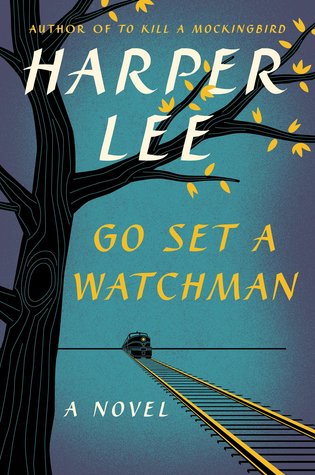
Because I'm officially #107 on the wait list at my library.
I keep going back and forth on whether I should just go buy the book, because, you know, all the potential for being the best (at least bestselling) novel of the year. But I just can't bring myself to pay hard cash for something I haven't read yet.
After all, #107's not too bad. If everyone maxes out their three week checkout limit I should get it by...
August 2021.
Ugh.
If you don't know what I'm talking about, you must not read the news. And I'm not even talking about the dorky book nerd news from book bloggers and Goodreads reviewers who stalk authors and publishing websites. This has been all over the real news too, because it's kind of that big of a deal that after decades of silence, the author that people thought had written only a one-hit-wonder has released a second novel, and it officially comes out today (although the entire first chapter was released last week).
A companion book for To Kill a Mockingbird? How could you not be excited?
Well, actually, finding out that the hero lawyer of American fiction, the upstanding Atticus Finch, might actually be a bigoted racist (technically not a spoiler, since it's already in the news) might be devastating. I mean, Atticus really was a national literary hero. I know a family that named their son Atticus (and I think they may have named a daughter Scout, but I might be making that part up). How are they going to feel about this change in the character's narrative arc?
But then again, characters are always better when they're complex. I am definitely intrigued.
Dang it, I want to read this thing.
Is it poor form to just hang out in a bookstore for hours on end while reading a book cover to cover? (Confession, I have done that before, but it was a short YA novel and only took me thirty minutes or so.) There's a chance I'd buy it, if I like it enough, but heavens, what would I do with the children while I read? Just let them run loose through the store?
To all my other bookish friends out there who get their hands on this book before me, I'm totally excited to hear your thoughts on this. Does it live up to the immortal To Kill A Mockingbird? Does it disappoint? Do you love it? Do you hate it?
And most importantly, can I borrow it?
Wednesday, June 24, 2015
What Makes a Book a "Beach Read"?

I took four books on our beach vacation last week, but it was only after I got back and made a trip to my local library branch that I realized I had taken all the wrong books.
You see, my local library had this cute little table set up with a big poster that said "Beach Reads!" and stacks of display books that all seemed to have the word "Beach" in the title, and all also seemed to revolve around light and fluffy chick-lit romances.
Now, don't get me wrong, I love myself a good fun chick-lit romance every now and then. And I love having some lighter books to break the pace in between heavy reads.
But why are these the only types of book deemed beach appropriate?
In my humble opinion, any book I happen to be reading while at the beach qualifies as a "beach read," and apparently I find it pretty okay to read some heavier and more literary stuff at the beach. But I'm not picky, I'll read some good children's lit there too. You know, I think I could just about read any book at the beach.
Honestly, there was no better time or place than our beach vacation for me to dive into some of these books, because I had lots of open hours to devote to reading that I don't normally have in real life. Also, there was family around to help watch and entertain my kids, which meant I got to do some uninterrupted reading. I even got one glorious hour alone on the beach while my husband took the boys back to the beach house for naptime. Seriously, that single hour made my entire summer. It was so luxurious.

Ideal reading spot.
I think it's time we do away with arbitrary definitions of what makes a book a "good" beach read. If it's a good book, it's a good beach read.
Agree? Disagree? What do you read at the beach (or the pool, or on vacation, or wherever)?
Monday, June 22, 2015
Here With Me (or, An Excuse to Trot Out Some Wedding Photos)
One of the books I read during our amazing beach vacation last week was The Book of Strange New Things by Michel Faber. There were many, many reasons I loved this book--the serious treatment of Christian belief in a literary setting, the whole concept of religious proselyting on an alien planet, the writing, I could go on--but the aspect of this book that stirred me the most, and will probably stay with me the longest, are the letters between a husband and wife physically divided by thousands of light-years.
Yes, this book may primarily be a genre-crossing literary Christian Sic-Fi novel, but at its core this book was really about the relationship between this preacher/missionary husband and the wife he left back home. It was the anatomy of a marriage undergoing the stress of physical separation.
My husband and I celebrated our seven year anniversary this past Saturday, so marriage has been on my mind recently. Specifically, what makes a marriage last.


Yes, this book may primarily be a genre-crossing literary Christian Sic-Fi novel, but at its core this book was really about the relationship between this preacher/missionary husband and the wife he left back home. It was the anatomy of a marriage undergoing the stress of physical separation.
My husband and I celebrated our seven year anniversary this past Saturday, so marriage has been on my mind recently. Specifically, what makes a marriage last.

We were such babies. Such young, young babies.
My husband and I had been dating seriously for a semester before we faced an eight month separation. After finals, I jetted off for a summer study abroad in Paris, and before I returned my then-boyfriend Nathan left for his semester of solo travel around the world/tutoring gig in Africa. Eight months of separation was a long time, and we discussed how we wanted to handle it before the semester ended. Should we just break up? Be allowed to date other people? Or say that we were still dating and try to keep the relationship up?

Nathan voted for keeping our relationship open, letting me be available to date other people, and then see where things stood when he returned the following year. At that point, however, I was pretty head-over-heels for this kid, and I was bound and determined to keep our relationship afloat with a serious letter writing campaign. Not only did I write and pre-date nearly twenty hand-written letters for him to take with him and open weekly on his trip around the world, but I also set aside time daily to write a lengthy email epistle. Over the summer, Nathan returned my daily emails (as well as phone calls when we could), but during his time in Africa he only had access to the internet about once a week, so the ratio was one letter of his for every seven of mine.
All of that history is to say that while reading this book last week, I had serious flashbacks to that time in our relationship when physically we were miles and miles apart, and the only thing connecting us was the words on a screen.


I'm convinced Michel Faber has experienced a long distance relationship himself, because some of those letters between the husband and wife were so real, so true. Honestly I felt like Faber had gone back and read some of my email archives because there were so many moments when I was like, HOLY COW I REMEMBER FEELING THAT EXACT EMOTION HOW DID HE KNOW!!!!! Granted, we weren't married at the time, and I certainly wasn't facing the apocalyptic crash of civilization while my husband was stuck on an alien planet (like the wife in the book), but reading the book, and reflecting on my own relationship, left me contemplating the nature of long-distance relationships.
Is physical proximity necessary to keep a relationship afloat? To keep two people connected?


The book itself leaves some doubt to the answer of that question, but in my own case, obviously, things worked out. Nathan returned and less than a month later we were engaged. In many ways the separation actually helped to develop and deepen our relationship, because apparently I express myself much better in writing than I do in person (and crucially, Nathan himself is a very thoughtful letter-writer as well). So our relationship was able to develop throughout the separation and be at an even stronger place when we were finally together again. And obviously, couples all over the world survive and thrive during long periods of physical separation (think of all those army wives).


That being said, separation is HARD. I would NEVER NEVER NEVER want to go through a separation that long again. I can handle the occasional week-long business trip, but I would make a miserable army wife.
Why is that? Why is physical proximity so beneficial, and in most cases crucial, for healthy relationships?
Is that a stupid question?
All I'm saying is that I'm terribly, terribly grateful that since our wedding, there have been very few nights that I've spent away from my husband. Even on those busy days when he comes home in time to scarf some dinner down just to disappear into the bedroom to work for the rest of the night, having him physically home is a million times better than having him stay at the office. We don't have to be doing anything together, just being under the same roof makes all the difference. Just being able to kiss him goodnight before going to bed is enough to satisfy me on those busy days. I just want him physically near.


It's been a wonderful, amazing, fantastic seven years with him by my side. Here's to many more years together, physically and metaphorically.
Thursday, May 28, 2015
Food: Some Convoluted Thoughts and Some Really Good Reads
I love food.
All the happiest memories of my life--holidays, travel, vacations, parties, family events--are so intrinsically linked with food that I can't tell if it's the event that made me love the food, or the food that made me love the event.
Just seeing paprika on potato salad takes me right back to my grandma's back yard barbecues in Preston, Idaho.
Caprese salad will forever remind me of the best meal of my life in Paris.
KFC chicken smells like Christmas Eve (I know, that one is a bit weird, but somehow my family adopted this strange tradition independently of the Japanese).
And while I loved them before, chocolate covered strawberries now revive all the wonderful emotions from my wedding day.
I don't consider myself a foodie, a connoisseur of delicacies, or even a particularly good cook (my husband is generous with his compliments, but my siblings are honest enough to keep me humble). But I love every part of a good meal. I love the anticipation, the planning, the cooking, the execution, and especially that time right after a good meal of feeling full and satisfied and perfectly at peace with the world.
But as much as I love food, my relationship with it is still complex (even more so when I'm pregnant). Nothing pleasurable in life comes without it's costs, it's stresses, and it's negatives. Food is no exception. Here are some of the complex aspects of my food relationships I've been thinking about recently.
Diet and Food Philosophies
Oh, the dreaded "D" word. I think for most women in this country, the number one single biggest negative issue with food is weight. This is actually not my issue. Between some lucky genetics and the nursing factor, I'm actually struggling to keep my weight up to a place where I don't look deathly emaciated (don't hate me, age gets the better of all of us and some day this metabolism will slow down). Weight might not be my issue right now, but health sure is. While I get to eat as much as a teenage boy, I still worry about the quality of those calories. I stress every day about how I should eat more fruits and veggies, less sugar and fewer carbs.
I think a lot about what kind of "diet" is most healthy for me and my family. By diet, I don't mean some three day juice cleanse or shedding a few pounds to fit in a wedding dress. I mean the regular way we eat, every day, in a sustainable kind of way. There are LOTS of philosophies out there. Should we be vegetarians? Or vegans? Or extreme raw vegans? Or go paleo? Or stick to Whole 30? Cut out gluten? Have I missed any of the current diet trends? The choices and arguments and data on all the different sides leave me spinning, and feeling extremely guilty when I serve carb-loaded pasta to my family every week.
Cost vs. Quality
More complex than even diet issues are the feelings I have about the cost of food. As a consummate underbuyer, I HATE spending money on food, a commodity meant to be consumed fairly quickly or else it will go bad, which makes it feel like a terrible investment. I absolutely at my core believe in cheap food. I admire this woman so much for being able to feed her family of seven (!) for $300 a month, and I heart Aldi with such a passion that I will drive 45 minutes one way just to shop there once a month and load up on basics and essentials. (The cost of gas doesn't even begin to compare to what that store saves us on food. For those of you who have never heard of Aldi, my condolences. I don't even remember how I used to shop before moving to the Midwest and discovering this treasure of a store.)
However, lower cost of food does tend to conflict with those dietary and food philosophy questions I wrangle with. Refined carbs are a very cheap way to feed a family, but they certainly aren't the healthiest. I know this, and thus the inner turmoil. I'm doing the best I can to feed us healthy foods, but when it gets down to the nitty gritty, I just can't bring myself to pay for grass-fed, organic, free-range, non-GMO food when the other stuff is so much cheaper. Maybe someday when those student loans are paid off I'll feel better about expanding our food budget a little to invest in higher quality food, but remember how I eat like a teenage boy? And how at that point my boys will probably be bottomless-pit teenagers? I will never completely stop serving those cheap carbs.
Time
So yes, I enjoy cooking fun meals every once in a while and getting creative in the kitchen. But when I have to feed four people three meals a day? Day after day after day? After day? It doesn't matter how much you love something, anything you have to do that much becomes a drudge chore pretty quickly. Which is why I love meal planning and quick dinners. 30 minute meals? With a baby whose crankiest hour is 5 PM, my meal prep has to be under 10 minutes or we ALL start crying. I recognize that in centuries past, women devoted most of their awake hours to food preparation. My own grandmother was this way. As soon as the breakfast dishes were cleared she would start in on lunch prep. Honestly, frozen dinners have done more than feminism to free women from domestic servitude, and yet, food prep is STILL the single biggest time suck of my life.
Why can't all food be extremely cheap, require little time to prep, be super healthy, and satiate the appetite of a teenage boy? Is this really too much to ask from life?
These issues aside, I still love food. A lot. And also reading about food. Honestly, reading about food is almost as good as eating food itself (except no, that's not true). I love all kinds of books on food: non-fiction that explores the issues I mention above, memoir that explores all the reasons to love food, and fiction with mouth-watering descriptions that leave me salivating. Without further ado (and holy cow, have I ever had more "ado" leading up to a list of books? I mean, talk about a long intro), here are a few books I've either read or want to read about this topic near and dear to my heart.
 In Defense of Food by Michael Pollan
Okay, so if there is a food "philosophy" I do want to ascribe to, it is probably the one Pollan outlines in this book: "Eat food. Not too much. Mostly plants." Really, this book had a more profound impact on the way I feed my family than anything out there. It actually got me to stop buying margarine and cough up the big bucks for real butter. That's saying something. This is the only Pollan I've read, though I hear his other stuff is good too. I highly recommend.
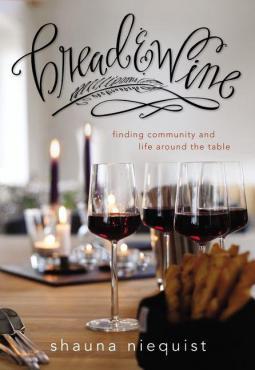 Bread and Wine by Shauna Niequist
Gosh, I just love this book so much. This book takes all of my issues about food and puts them in perspective. Niequist makes food about people. About nurturing and feeding people. It's beautiful stuff, and I can't recommend this book more highly. It's one worth owning.
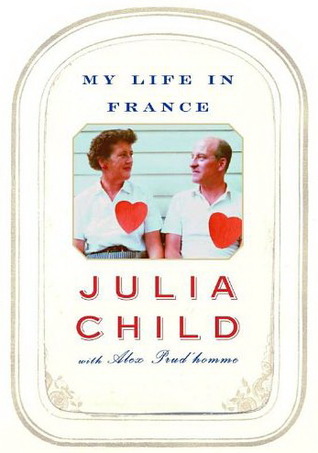 My Life in France by Julia Child
Oh, Julia. The icon, the figure, the force, in her own words. She was quite a lady, and while I didn't love everything about this book, I found her passion for cooking to be really inspiring. Also, her love of the French. I share that with her. They just know how to do food.
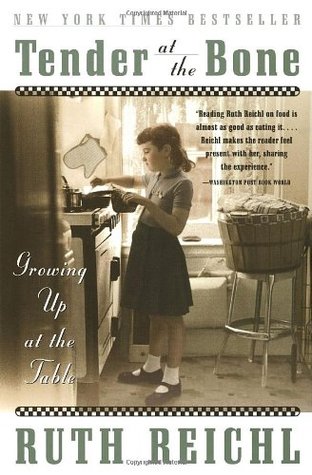 Tender at the Bone by Ruth Reichl
I read Delicious! by Reichl, but I have a sneaking suspicion I will enjoy her nonfiction more than her fiction. I've heard such great things, I'm excited to get this one off my to-read list.
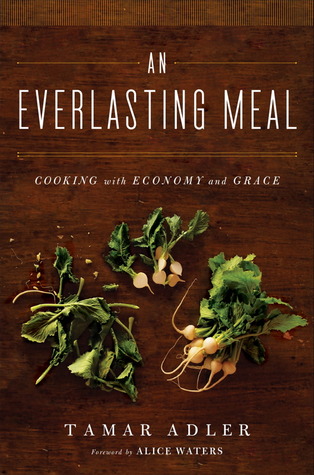 An Everlasting Meal by Tamar Adler
The tag-line to this one is "Cooking with economy and grace." Yes, please! I've read glowing reviews of this book, and it sounds fabulous. Part cooking-instruction, part food philosophy, this sounds like the kind of book I'd love to sink my teeth into (lame pun? sorry).
And in honorable mention, my favorite movie about food of all time:
 Babbette's Feast
Okay, if you can remotely appreciate good foreign films, this one is a MUST WATCH at some point in your life. The food! Oh, the food! And the story! And the characters! Such a good, sweet, amazing, mouth-watering movie.
Okay, what's missing from this list? What books about food should be on my to-read list? What are your own thoughts/feelings/issues with food?
All the happiest memories of my life--holidays, travel, vacations, parties, family events--are so intrinsically linked with food that I can't tell if it's the event that made me love the food, or the food that made me love the event.
Just seeing paprika on potato salad takes me right back to my grandma's back yard barbecues in Preston, Idaho.
Caprese salad will forever remind me of the best meal of my life in Paris.
KFC chicken smells like Christmas Eve (I know, that one is a bit weird, but somehow my family adopted this strange tradition independently of the Japanese).
And while I loved them before, chocolate covered strawberries now revive all the wonderful emotions from my wedding day.
I don't consider myself a foodie, a connoisseur of delicacies, or even a particularly good cook (my husband is generous with his compliments, but my siblings are honest enough to keep me humble). But I love every part of a good meal. I love the anticipation, the planning, the cooking, the execution, and especially that time right after a good meal of feeling full and satisfied and perfectly at peace with the world.
But as much as I love food, my relationship with it is still complex (even more so when I'm pregnant). Nothing pleasurable in life comes without it's costs, it's stresses, and it's negatives. Food is no exception. Here are some of the complex aspects of my food relationships I've been thinking about recently.
Diet and Food Philosophies
Oh, the dreaded "D" word. I think for most women in this country, the number one single biggest negative issue with food is weight. This is actually not my issue. Between some lucky genetics and the nursing factor, I'm actually struggling to keep my weight up to a place where I don't look deathly emaciated (don't hate me, age gets the better of all of us and some day this metabolism will slow down). Weight might not be my issue right now, but health sure is. While I get to eat as much as a teenage boy, I still worry about the quality of those calories. I stress every day about how I should eat more fruits and veggies, less sugar and fewer carbs.
I think a lot about what kind of "diet" is most healthy for me and my family. By diet, I don't mean some three day juice cleanse or shedding a few pounds to fit in a wedding dress. I mean the regular way we eat, every day, in a sustainable kind of way. There are LOTS of philosophies out there. Should we be vegetarians? Or vegans? Or extreme raw vegans? Or go paleo? Or stick to Whole 30? Cut out gluten? Have I missed any of the current diet trends? The choices and arguments and data on all the different sides leave me spinning, and feeling extremely guilty when I serve carb-loaded pasta to my family every week.
Cost vs. Quality
More complex than even diet issues are the feelings I have about the cost of food. As a consummate underbuyer, I HATE spending money on food, a commodity meant to be consumed fairly quickly or else it will go bad, which makes it feel like a terrible investment. I absolutely at my core believe in cheap food. I admire this woman so much for being able to feed her family of seven (!) for $300 a month, and I heart Aldi with such a passion that I will drive 45 minutes one way just to shop there once a month and load up on basics and essentials. (The cost of gas doesn't even begin to compare to what that store saves us on food. For those of you who have never heard of Aldi, my condolences. I don't even remember how I used to shop before moving to the Midwest and discovering this treasure of a store.)
However, lower cost of food does tend to conflict with those dietary and food philosophy questions I wrangle with. Refined carbs are a very cheap way to feed a family, but they certainly aren't the healthiest. I know this, and thus the inner turmoil. I'm doing the best I can to feed us healthy foods, but when it gets down to the nitty gritty, I just can't bring myself to pay for grass-fed, organic, free-range, non-GMO food when the other stuff is so much cheaper. Maybe someday when those student loans are paid off I'll feel better about expanding our food budget a little to invest in higher quality food, but remember how I eat like a teenage boy? And how at that point my boys will probably be bottomless-pit teenagers? I will never completely stop serving those cheap carbs.
Time
So yes, I enjoy cooking fun meals every once in a while and getting creative in the kitchen. But when I have to feed four people three meals a day? Day after day after day? After day? It doesn't matter how much you love something, anything you have to do that much becomes a drudge chore pretty quickly. Which is why I love meal planning and quick dinners. 30 minute meals? With a baby whose crankiest hour is 5 PM, my meal prep has to be under 10 minutes or we ALL start crying. I recognize that in centuries past, women devoted most of their awake hours to food preparation. My own grandmother was this way. As soon as the breakfast dishes were cleared she would start in on lunch prep. Honestly, frozen dinners have done more than feminism to free women from domestic servitude, and yet, food prep is STILL the single biggest time suck of my life.
Why can't all food be extremely cheap, require little time to prep, be super healthy, and satiate the appetite of a teenage boy? Is this really too much to ask from life?
These issues aside, I still love food. A lot. And also reading about food. Honestly, reading about food is almost as good as eating food itself (except no, that's not true). I love all kinds of books on food: non-fiction that explores the issues I mention above, memoir that explores all the reasons to love food, and fiction with mouth-watering descriptions that leave me salivating. Without further ado (and holy cow, have I ever had more "ado" leading up to a list of books? I mean, talk about a long intro), here are a few books I've either read or want to read about this topic near and dear to my heart.
Okay, so if there is a food "philosophy" I do want to ascribe to, it is probably the one Pollan outlines in this book: "Eat food. Not too much. Mostly plants." Really, this book had a more profound impact on the way I feed my family than anything out there. It actually got me to stop buying margarine and cough up the big bucks for real butter. That's saying something. This is the only Pollan I've read, though I hear his other stuff is good too. I highly recommend.
Gosh, I just love this book so much. This book takes all of my issues about food and puts them in perspective. Niequist makes food about people. About nurturing and feeding people. It's beautiful stuff, and I can't recommend this book more highly. It's one worth owning.
Oh, Julia. The icon, the figure, the force, in her own words. She was quite a lady, and while I didn't love everything about this book, I found her passion for cooking to be really inspiring. Also, her love of the French. I share that with her. They just know how to do food.
I read Delicious! by Reichl, but I have a sneaking suspicion I will enjoy her nonfiction more than her fiction. I've heard such great things, I'm excited to get this one off my to-read list.
The tag-line to this one is "Cooking with economy and grace." Yes, please! I've read glowing reviews of this book, and it sounds fabulous. Part cooking-instruction, part food philosophy, this sounds like the kind of book I'd love to sink my teeth into (lame pun? sorry).
And in honorable mention, my favorite movie about food of all time:
Okay, if you can remotely appreciate good foreign films, this one is a MUST WATCH at some point in your life. The food! Oh, the food! And the story! And the characters! Such a good, sweet, amazing, mouth-watering movie.
Okay, what's missing from this list? What books about food should be on my to-read list? What are your own thoughts/feelings/issues with food?
Monday, March 16, 2015
5 Life Lessons From My De-Cluttering Binge

Over the past year or so, I had many excuses to explain away the clutter: I was pregnant, I had a new baby, I was sick, our tiny apartment was too small for a four-person growing family, if we lived in a house it would all be better. . .
But I finally confronted the truth. All excuses aside, we were just lazy, disorganized, messy people.
The beds were never made, there were always dirty dishes spread over all the counters, books and clothes and toys and mail and whatever random crap just piled up everywhere. I about died of shame any time anyone popped over for a surprise visit.
It was depressing.
So when I came across Marie Kondo's book, The Life-Changing Magic of Tidying-Up, at my local library, I grabbed it up eagerly. I knew we needed help, and something had to change.
Okay, let's start with the caveats. Marie Kondo is Japanese. All of her clients are Japanese, and it is obvious that all of her experience with organizing and decluttering is heavily influenced by her culture (sometimes I had images of neon flashing Hello Kittys or big-bellied Buddhas speaking to their underwear coming through her advice). Not everything she says or does translates perfectly to an American home. She never addresses how to handle holiday decorations, her aesthetic is clearly much more spare and modern than most Americans are comfortable with (unless you really dig that minimalist, modern look, which is cool if you do, but I find it depressing), and she does NOT have kids. Or a husband, as far as I can tell.
And yeah, if I didn't have a husband and kids, I'd like to think my little apartment would be sparkling clean all the time.
BUT, caveats aside, I literally found this book to be LIFE CHANGING! I know, it sounds extreme. Let me see if I can explain.
Kondo has developed and perfected a method (the "KonMarie" method) for organizing and tidying that she guarantees, if followed, will lead to life-long organization. She claims that she has a 100% success rate, and that none of her clients have ever relapsed. You can't argue with numbers like that, so I was more than game to try out her method.
She has five categories of things to declutter and organize:
1.) Clothes
2.) Books
3.) Papers (Files, etc.)
4.) All Other Objects
5.) Sentimental Things
To follow her method completely, you must tackle each of these categories in order (the order is very important to her), and proceed to throw out or keep items based on the criteria of whether or not it brings you joy. Then you organize only the possessions that bring you joy in a logical way where everything has a place. She goes into much more detail in the book with suggestions and tips I don't have space to discuss here, some of which I found super helpful, and some of which I'm going to ignore completely (she had some super extreme and ridiculous suggestions, I just looked past those).
As soon as I finished the book, I jumped into my own decluttering project, sticking as close to her method as I found practical. So far I've worked my way through my clothes and books (the story of my books deserves it's own post), and I'm working through my papers, but this is a HUGE project. It is going to take months to finish, but this process has already been so transformative for me. I've had so many epiphanies, finally internalized lessons I've heard all my life but never taken to heart, and learned things about myself as well. Really, I am not over exaggerating when I say the process of organizing my home has been life-changing.
Here are a few of the epiphanies I've had through this experience:
A House of Order
When I think about my home, this home that I am creating, and the ideal home I want to have, certain words come to mind. PEACE is a big one. JOY is another one. I want a home that is peaceful, calm, filled with joy and light and happy memories. And when I imagine what this home looks like, clutter is not a part of it. This home isn't obsessively clean, or stark and bare (no home with children should be), but it is a home where things have a place, and they are generally kept in place. I want a house of order, and this process has helped me focus that vision and bring it closer to reality.
"Joy" as a Material Philosophy
I've been searching for a philosophy about how to relate to material possessions. Our consumer culture focuses very much on "More! More! More!" and sometimes it's hard not to feel that pull. However I think we all recognize that's not a healthy way to think about things. The philosophy in my home growing up was "Necessity vs. Want," and while I think this is a much healthier view of things, I've talked before about how sometimes there is a fuzzy line between needs and wants, and this wasn't providing clear guidance for me. I've dabbled in the Zero Waste Home philosophy (way too stressful for me) and other minimalist philosophies, but ultimately, none of these philosophies really spoke to me.
But when Kondo started talking about only keeping things that bring you joy, that totally clicked with me. Suddenly, it doesn't have to be about whether I need it or only want it, it doesn't have to be about function, or hoarding, or not being wasteful, or other things that tended to add stress to my life. Instead, it gets to be about joy! This idea has been super profound for me. Not only is it allowing me to let go of A LOT of things we already have (we've hung on to so many ugly, low quality, broken, or underused things because it felt wasteful to throw them out), it's changing the way I bring things in. Now when I shop, instead of asking questions about value and discount and coupons and sales that leave my head spinning, I think about whether it brings me joy. When it has to actually bring you joy, you buy a lot less stuff.
Revolutionary.
Outer Order Brings Inner Calm
Possessions carry a lot of weight. Not just physically, but mentally. I really felt this the last time we packed up our lives and moved across the country (the event that started me thinking about a minimalist philosophy), but I can't believe all the stuff I still felt was necessary to hang on to (like that box of all my lesson plans from when I taught school years ago. I have them all on my computer, why have I been lugging around the physical paper? Why?) It wasn't until I started throwing things away that I realized how great it felt mentally to let that weight go. Life feels lighter, physically and mentally. I feel more in control. I feel calmer and more at peace.
Order Creates Energy
One of the things that worries me the most is the effort it takes to keep things tidy and organized. Laziness has always been the cause I've attributed to all the clutter. I'm just too lazy to clean up and put things away. It takes effort.
But what I've noticed from this experience is that when I REALLY focus on the joy of my possessions and finding the perfect way to organize them, it creates the energy and motivation in me to keep it up. Kondo talks about how no one who follows her method ever relapses, and I think it's because of this energy that is created by the order. You feel so good when everything is in the right place, when you only have things you love, that you don't want to lose that good feeling by not taking the extra five seconds to fold your pants and put them away. At least that's the way it's been working for me.
Everyone Needs a Sapce
At the end of her book, Kondo talks about how everyone needs a space, a place for their things that are their own. Considering that in my entire life I've NEVER had my own room, this idea really struck a chord with me. It also helped me gain perspective on how to deal with the tidyness habits of those I live with. As much as I like to think that this little home is my domain and I have control over everything in it and can force tidyness on everyone, that is simply not true. Kondo says (after making this mistake herself) that you should never throw out or reorganize the possessions of any other person. I'm trying to respect this line with my husband, and leave his possessions and his space to himself. However, I'm finding that my new tidyness obsession is contagious; my husband has asked for my help cleaning out his clothes too and got really excited over the idea of getting bookshelves for his game collection. I'm even trying to respect this line with my three-year-old, while at the same time teaching him how to care for his possessions and keep them tidy. It's an experiment right now, this realm of kids and clutter, one I'm still working through, but I'll write it about it in more depth some day.
This process of decluttering and reorganizing my life has been a profound experience for me. Even though I understand how this book might not be for everyone (you really have to read past the cultural quirks) I highly recommend a good decluttering binge. Look for more posts as I continue to work on this process over the next few months. I'm hoping there are even more lessons to be learned.
Thursday, January 22, 2015
Reasons to Reread
I still remember sitting in my honors geography class in 9th grade, and my teacher Mr. Melessa being floored that so many of us, his bright smart honor students, reread books. "There are so many new books to read," he said. "Why would you waste time reading something you've already read?"
It's a good thing he was a geography teacher and not an English teacher.
Still, I've put a lot of thought into this question over the years. Because it's true, right now my to-read list on Goodreads has more books on it than my "read" list, which means if I focused singularly on getting through my to-read list it would take me at least five years (is that really how long I've been using Goodreads?) And of course it would actually take longer, because I add books to that to-read list almost daily, so there will never be a day when I get through them all. There will always be new ones to add.
So why would I waste my time reading something I've already read?
I'm sure everyone has a different reason for rereading a favorite book, but there are plenty of reasons. My most reread books tend to be religious or other non-fiction that I want to apply to my life. Application requires constant reminding, and so I revisit those books every now and then to inspire and rededicate myself to better living.
Sometimes I revisit books for sheer pleasure. It doesn't matter how many times I've read it before, Harry Potter never seems to get old.
And sometimes I revisit a book because I'm fascinated how every reread seems to reveal a completely new story, while still feeling like a comfortable old friend. For me, this is the case with Jane Austen.
For my virtual book club this past month, we decided to reread Pride and Prejudice. The first time I read this book (when I was in 6th grade) I was surprised at how funny it was, and I laughed my way through the whole book. When I reread it in high school I of course fawned all over Mr. Darcy and lamented how none of the boys I knew could ever possibly live up to him. When I reread it in college, I found myself super annoyed at Lizzie. What a stupid girl she was! How could she be so blind and prejudiced?
And with this most recent reread, I found myself really focusing on the various marriage relationships, especially the Bennetts and the Collinses. For a woman who was never married Austen sure understood relationships, especially the imperfect ones. This is the first time I've reread P&P since being married myself, and so I realized all the nuances in these relationships that I'd never really picked up on before. It was a great experience to reflect on what actually makes a marriage work and, even though Lizzie and Darcy are touted as being the perfect couple, Austen makes a great case in this book for finding contentment even when your partner is less than perfect. It's really quite deep stuff.
I'm getting excited already thinking about the next Austen book I want to reread (but it probably won't happen for a while, what with school starting up again this week).
So, are you a rereader? What are your reasons for rereading? What are your favorite books to reread?
Thursday, July 24, 2014
Getting My Pleasure Reading Groove Back

Pleasure reading has always been my thing. And I mean, since like first grade I've ALWAYS had a book I was deep in the middle of, one I carried around with me and sneakily read under my desk when classes got boring (although after being a teacher myself, I realize I was probably fooling no one. I've even been annoyed by a few students who I knew were distracted by books under their desks, but then I would remind myself that, as an English teacher, that's exactly the life skill I was trying to encourage, and if my lesson that day wasn't interesting to them, well, that was my fault.) (Also, never tell this to my boss, but I used to keep a book hidden in my desk drawer when I worked in university administration., and would read when things were slow, only to slam my desk drawer closed whenever anyone walked by my work space).
Anyway, I've just always been the kind of person to have a book going, to be plowing through my to-read list, and to actually pace myself so I didn't spend ALL my time reading.
But recently? I don't know if this pregnancy is messing with my brain, or if I'm just losing it, or what, because pleasure reading has been way, way down on my to-do list. In fact, on our recent family vacation, I didn't take a single book with me. I'm not sure I even thought about it when I was packing. I had a few audio books on my phone, but considering that my phone was the go-to toddler-distraction-device on all our plane flights and car rides, I didn't actually get a chance to listen to anything. I can't tell you how many times I thought, "I wish I had a book with me." It was such a strange, out-of-character move on my part, that honestly I'm completely flabbergasted by it. How did I not pack even one book? What was I thinking?
But the truth is, I've just been struggling to fit pleasure reading into my life for a few months now. And this is not acceptable. This is not who I am. So I've been consciously working on a few strategies to get me going again, and I thought I'd share them here, just to remind myself in the future in case I ever go through this weird phase again.
1. Have lots of books on hand. When I got home from that family vacation, I immediately went online and put about ten books from my to-read list on hold at my library. I've got about five now sitting on my bedside table, reminding me they need to be read.
2. Give yourself a deadline. I've found that I tend to read library books with more alacrity than the books I actually own, because I know I have to return them. That forced deadline works wonders on my motivation to start a book (whether I finish depends on the book).
3. Have different media options going at once. By this, I mean I need to have audio books, e-books, and good old paper books available to me at all times. In the first two years of motherhood, I totally converted to audio books, and tried to get my hands on the audio version of every book I wanted to read. It was just so much more convenient for multi-tasking with a baby. But recently, I've found that paper books are a little more convenient for this stage of my life (or really, my toddler's stage of life). And e-books are always handy for out and about (it's easier to slip my e-reader into my purse for the doctor's office waiting room than some massive hardback). Anyway, it's just good to have options, for whatever situation is at hand.
4. Read what you like. So, I've got a couple of books going right now that are "should read" books about pregnancy and parenting. Now, I'm a total advocate for reading books to stretch your mind, learn new things, and enrich your life experience. And these pregnancy books are very good and interesting and things I want to read. But in my current situation, where I'm struggling to find motivation to read on a daily basis, the dryer tone of these books isn't helping much. I found myself thinking the other day, "I just wish I had a really good YA fantasy to lose myself in right now." Ask and ye shall receive. I got an email the next day saying my hold for Dreams of Gods and Monsters was available, and I kind of dropped everything to indulge in it for a few days. When you're struggling with pleasure reading, read what is absolutely most pleasurable to you.
5. Make reading an established part of your routine. This is the one that's been the biggest culprit for me, because I feel like my routine has been all disrupted lately (i.e. sleeping so much more than I used to, it really takes a bite out of my reading time). I finally decided to let myself read a chapter or two before bed each night. This used to be a huge no-no for me, because of the ever-present danger of getting sucked into a book and then not putting it down until the wee hours of the morning. But it's a risk I'm taking now because most days, I don't find any time to read until I'm climbing into bed.
6. Make it a priority. This last piece of advice isn't as concrete as the others, but it's still important. I think pleasure reading has been falling off the grid for me because other things are feeling more important. Or generally because I just feel exhausted all the time (yay for being pregnant!). But when I stop and think objectively, I really want pleasure reading to be a part of my life. That's not just the kind of person I am, it's also the kind of person I want to be, even if I have to work a little harder at it. I just have to view reading time as important and worth the effort. Because it is.
Do you ever have reading slumps? What helps you get over them?
Tuesday, June 17, 2014
A Few Bookish Tidbits
You guys, June is killing me. I mean, how are we over half way through this month? Where is my lazy summer going? (Oh yeah, I might be sleeping it away).
Anyway, here are a few bookish things from the internet I've been reading/pondering/interested in recently.
1. This article from Slate made the rounds on my Facebook feeds a couple of weeks ago, and I can't stop thinking about it because it made me so angry. Adults should be ashamed to read YA literature!? Obviously, this sad author has lost touch with her childhood, her innocence, and any sense of decency, and I feel bad for her. It's not that I love The Fault in Our Stars so much (I don't), but I will stand up unequivocally for the value of young adult and children's literature. Take, for instance, this paragraph:
2. This little list from NPR last week made me super happy. I can't say I remember the show Gullah Gullah Island, but Reading Rainbow? Wishbone? These were the shows that defined my childhood! There are so many books today that I can't look at without remembering that little dog costumed as the main character. Also, my husband can still sing the entire theme song to Where in the World is Carmen Sandiego. Yep, we had some quality public programming in those days.

3. You guys, I need my favorite bookish bloggers to stop posting summer reading guides, because my to-read list has exploded recently, even as my time devoted to actual reading has plummeted. It's a conundrum for sure. Nevertheless, if you find yourself looking for that next great read this summer, my two favorite guides so far have been this one by Janssen at Everyday Reading and this one by Modern Mrs. Darcy.
4. Okay, so I was totally late to the Lizzie Bennett Diaries bandwagon, but after finally stumbling across it I binge watched all 100 episodes over two days (each episode is only five to ten minutes). It was a fantastic web-video-blog (whatever the word is) adaptation of Pride and Prejudice, and I loved it, so I was delighted to discover Emma Approved last month (still late to the game, but only half-way through this time), which is obviously an adaptation of Emma. I think this new series is a bit less charming (it took me a lot of episodes to warm up to Emma), but I still highly recommend it to all those Austen-obsessed fans out there. However, they're only on episode 53 right now, so you might want to wait until all the episodes have been released and binge watch it all at once (a highly satisfying, if time consuming experience). Either way, it's a fun way to experience Austen.
Anyway, here are a few bookish things from the internet I've been reading/pondering/interested in recently.
1. This article from Slate made the rounds on my Facebook feeds a couple of weeks ago, and I can't stop thinking about it because it made me so angry. Adults should be ashamed to read YA literature!? Obviously, this sad author has lost touch with her childhood, her innocence, and any sense of decency, and I feel bad for her. It's not that I love The Fault in Our Stars so much (I don't), but I will stand up unequivocally for the value of young adult and children's literature. Take, for instance, this paragraph:
Most importantly, these books consistently indulge in the kind of endings that teenagers want to see, but which adult readers ought to reject as far too simple. YA endings are uniformly satisfying, whether that satisfaction comes through weeping or cheering. These endings are emblematic of the fact that the emotional and moral ambiguity of adult fiction—of the real world—is nowhere in evidence in YA fiction. These endings are for readers who prefer things to be wrapped up neatly, our heroes married or dead or happily grasping hands, looking to the future. But wanting endings like this is no more ambitious than only wanting to read books with “likable” protagonists.How sad! How sad indeed that adults are only allowed "emotional and moral ambiguity" and we should feel ashamed to believe that stories actually should have endings. Excuse me if I believe in happy endings.
2. This little list from NPR last week made me super happy. I can't say I remember the show Gullah Gullah Island, but Reading Rainbow? Wishbone? These were the shows that defined my childhood! There are so many books today that I can't look at without remembering that little dog costumed as the main character. Also, my husband can still sing the entire theme song to Where in the World is Carmen Sandiego. Yep, we had some quality public programming in those days.
(Source)
3. You guys, I need my favorite bookish bloggers to stop posting summer reading guides, because my to-read list has exploded recently, even as my time devoted to actual reading has plummeted. It's a conundrum for sure. Nevertheless, if you find yourself looking for that next great read this summer, my two favorite guides so far have been this one by Janssen at Everyday Reading and this one by Modern Mrs. Darcy.
4. Okay, so I was totally late to the Lizzie Bennett Diaries bandwagon, but after finally stumbling across it I binge watched all 100 episodes over two days (each episode is only five to ten minutes). It was a fantastic web-video-blog (whatever the word is) adaptation of Pride and Prejudice, and I loved it, so I was delighted to discover Emma Approved last month (still late to the game, but only half-way through this time), which is obviously an adaptation of Emma. I think this new series is a bit less charming (it took me a lot of episodes to warm up to Emma), but I still highly recommend it to all those Austen-obsessed fans out there. However, they're only on episode 53 right now, so you might want to wait until all the episodes have been released and binge watch it all at once (a highly satisfying, if time consuming experience). Either way, it's a fun way to experience Austen.
Subscribe to:
Posts (Atom)