Yeah, this is a book blog or whatever, but who doesn't love a good birth story? And in my personal opinion, this is a good birth story. At least, it has a very happy ending.
For those of you who read my private family blog, this may be a bit redundant, but there are a few juicier details here.
So, for a little background. My first pregnancy's labor and delivery was a bit traumatic for me. After 15 hours of active (induced) labor, a horrible epidural, 3 1/2 hours of pushing, an emergency C-section, and a terrible recovery, the experience was anything but ideal. Due to issues with the epidural not working very well during the C-section, they ended up knocking me out completely after the baby was out. I didn't get to really see, let alone hold my baby for another ten hours. Breastfeeding was a nightmare, both because my son's first meals had been formula and he got used to a full belly, and also because of the C-section scar. I had a very difficult time holding him in position to get a good latch. I know it was mostly due to the strong waves of hormones coursing through me after birth, but I couldn't help feeling like a failure. My body had failed to push this baby out (granted, he was 9 lbs 5 oz. with a ginormous head, and the doctor said he never was going to fit through my petite frame), and I was failing at taking care of my child. That first week of his life was incredibly stressful and emotional for me.
Needless to say, I was bound and determined to have a different experience with this second pregnancy. I found a doctor that was very experienced with VBACs. I did all the research and read all the books and pretty much got very convinced that in order to have a successful VBAC I needed to have as natural and intervention-free of a labor as I possibly could.
Due to some thyroid issues in my first trimester, some anemia issues in my second trimester, and what I can only assume were some general hormone issues throughout the whole pregnancy, I always felt sick and exhausted and generally miserable. Which is why I kept putting off preparing for this baby. I always felt too tired, plus I had plenty of time. I wasn't due until October, so when September hit I remember thinking, No worries, I've still got a whole month to get things ready.
So imagine my surprise when on September 9th, at only 36 weeks along and on a grocery shopping trip with my toddler, I started feeling some major cramping. I booked it home, threw my kid in his crib for quiet time, and tried to sleep it off myself. But when the cramping and contractions kept getting stronger through the afternoon, I finally called my husband and begged him to come home from work early. I didn't think I was in labor, but I was in enough pain that I couldn't face dinner and bedtime routine alone. Needless to say, my husband found this episode really concerning, and even though the contractions ended up subsiding later in the evening, he was worried enough that he took work off the next morning to come to my doctor's appointment with me.
At the appointment, my doctor confirmed that indeed, I had experienced some real pre-labor contractions. I was dilated to a three and nearly completely effaced. My husband asked what that meant in terms of when this baby would come, and my doctor said, "Well, she could have this baby tonight, or it could come in another three weeks." Based on my experience with my first baby, I thought we probably had some time, but I was certainly praying it wouldn't be three weeks.
We went home, and I put myself on a self-imposed bed-rest for the next few days. We put friends and family on notice, my husband desperately tried to finish up some projects at work so he could leave at a moment's notice, and we spent the weekend sorting baby clothes and pulling all our baby gear out of storage. Finally we settled in to wait.
And wait.
And wait.
The two weeks that followed were perhaps the most miserable of my life. Contractions became the constant background of my daily existence. Any sort of movement or activity (like getting off the couch to go to the bathroom) could trigger a bout of contractions or cramps. They were much stronger and more painful than the Braxton-Hicks I'd been experiencing for several months, and they would often stick around for several hours at a time before fading away. There were episodes when the contractions would become very strong and painful, and I would think This is it! I'm finally in labor!, but they never became consistent or regular, and in the end they would always fade to a dull ache. These contractions left me incredibly sore. I tried going to church the first Sunday, and even took my own pillows to sit on, but it was terrible. I hobbled out of the meeting two hours later like an old woman, I could barely walk. I didn't leave the house much after that, because I was nearly physically incapable of it. I never slept well. I couldn't sit or stand or even lie in one position for too long. I could barely take care of myself, let alone my toddler. Things were pretty desperate.
At my 38 week doctor's appointment, I had an ultrasound to measure the size of the baby. These estimates are never very accurate, but the measurements came back at 8 lb. 4 oz. My doctor was concerned that if it took much longer for me to go into labor, this baby would grow too big and we'd have a repeat situation of my first pregnancy. As I was already dilated to a 4, she offered to induce me at 39 weeks. I was surprised by the offer, because she'd told me repeatedly from the beginning that she never induced VBACs, and I didn't want to be induced again anyway, but as soon as she made the offer for an induction I felt very peaceful that this was a good direction to go. After all, I still had over a week to wait to go into real labor on my own, and I could decline the induction at any time.
And so I endured another week of physical and mental torture. By the end, I was going a little bit crazy. My body was completely exhausted from being in perpetual labor, and I was ready to be done. There's a part of me that really wants to believe that if I had just waited long enough, eventually my body would have had to go into real labor. But there's another part of me that isn't so sure. There's a strange little family pattern between my mom, my older sister, and me. Among our combined nine pregnancies, not a single baby has been delivered without the help of pitocin. In fact, I'm the only one that has actually experienced any form of natural contractions. Perhaps all these inductions speak more to the medical profession's tendency to intervene, but after a lot of prayer and consideration on my part, I couldn't help but feel that waiting to have this baby naturally would only increase my chances of needing a C-section, and this baby was ready to come sooner rather than later.
And so, on September 26th, 17 days after my first contractions started, we dropped our son off with some friends and finally made our way to the hospital. I was dilated to a 5, and fully effaced. Despite the fact that I had agreed to be induced, I still wanted to avoid an epidural at all costs. This was actually one of the things I was most nervous about, because I knew that contractions on pitocin are supposed to be way more intense than natural contractions, and I worried that I wouldn't be able to handle the pain. Here is where I need to give a shout-out to my e-friend Amy. She was the first person I'd ever heard of that had actually delivered not just one, but four babies on pitocin without an epidural. She generously sent me all of her beautiful birth stories, and I was completely inspired. I knew it was at least possible, and so I convinced myself that I could do it too.
My attending nurse tried very hard to convince me otherwise. I did not like my nurse very much at the beginning (she grew on me by the end). She gave us all these statistics about how low my chances were at having a successful VBAC and about how incredibly risky it was that I was being induced (I didn't realize it when my doctor made the offer, but pitocin increases the risk of uterine scar rupture, which is why doctors usually never induce a VBAC), and she assured us she had the operating room all prepped because it was very likely I would end up with another C-section. She told me if I didn't have the epidural, they would have to knock me out again in the case of an emergency. I was pretty upset by all of this, but bless my doctor! I had talked to her about my desire to avoid an epidural, so when she came into the room and saw me filling out the anesthesiology consent forms, she said in a surprised voice, "Oh! Are you getting an epidural?" And when I told her I wanted to hold off on making that decision, she totally backed me up and said, "Yes, well, I would like you to be feeling contractions before you decide." So, the nurse backed off and I got to put off the epidural question.
They started the pitocin drip at 1 PM, and my doctor broke my water soon after that. My nurse said she would check me again at 3 PM. I was relatively comfortable for the first hour. I enjoyed being able to move around, I got up to go to the bathroom, and I played a game with my husband on his phone. But during the second hour, things got pretty intense rather quickly. I had my husband turn on some music, rolled onto my side, and had him massage my back through each contraction. The pain quickly escalated to a level I had never experienced before, and I found myself clinging to the side of the bed, making these pathetic whimpering noises, feeling like I was going to pass out, and trying desperately NOT TO MOVE. It seems ironic now that one of the reasons I didn't want an epidural is because I wanted to be able to move around and labor in different positions, but when I was actually in the middle of it, my only goal became to move as little as possible. For some reason I felt like moving at all would kill me.
I tried really hard to remember all of the breathing and relaxation techniques I had read about and practiced, but honestly, I had a hard time focusing on anything. At the height of each contraction, the promise that the epidural could take all this pain away was honestly the most tempting thing in my life. Luckily, during the lull between contractions I was able to relax enough to tell myself that I could endure one or two more contractions without an epidural. I just had to survive through the next one.
At 3 PM, my nurse came back in to check me. She announced that I was dilated to an 8, and then she said if I wanted the epidural, it was now or never. I remember thinking Don't tempt me! I'm going to last through two more contractions, and then I'll give in and get the epidural. But at this point, I wasn't really capable of talking so I didn't actually respond to the nurse. She got really busy at this point, calling my doctor, wheeling in the delivery table, and running around like things were about to happen. I wasn't sure why she was in such a hurry, because I had convinced myself that I still had hours and hours ahead of me, so imagine my surprise when a mere fifteen minutes later I felt that uncontrollable urge to push, and finally found my voice to announce that to the room.
My doctor came in at this point with a few other support nurses, and they set about rolling me onto my back. I was NOT happy about this because it HURT SO BAD TO MOVE. I kept telling the nurse that I did not want to move to my back, and she kept telling me that I HAD to if I wanted to deliver this baby, and I remember thinking, No, I do NOT have to be on my back! I've seen Call the Midwife! But of course, I was in no condition to actually make that astoundingly logical argument, so onto my back I went.
They started coaching me through the pushing, and this is the point when I became extremely grateful that I'd held out and not gotten the epidural, because what a night and day difference between my first pregnancy! I could actually feel the baby! I could feel where I needed to push! I could feel the progress as he moved down the birth canal. I could feel myself stretching, and I could feel when I needed to push harder. The contractions became so much easier to bear because I was focused on the sensation, and it felt so productive. I was still mentally prepared for this part of the experience to take several hours (remember I pushed for 3 1/2 hours with my first before the C-section), so I tried not to get too excited when they talked about seeing the head, or told me I was doing well (I'd heard all that before, it didn't mean anything to me). But when my husband finally asked if it looked like it was going to work, or if the baby was stuck, the nurse said, "Oh, this baby is coming out vaginally, no question," I finally let myself believe this was really happening.
It took 45 minutes. Forty-five blessedly short minutes before I felt the release as the head emerged, and then the rest of the body wriggle through with that last contraction. They held up that wriggling, squirmy baby, my husband cut the umbilical cord, and they handed him up to my chest. And there he was. My perfect little baby that I had pushed into this world, snuggled in my arms.
It was absolutely one of the best moments of my life.
I had done it. I beat the odds. I labored on pitocin without an epidural. I pushed an 8 lb. 10 oz. hunk of a baby out of my body. I welcomed that baby into this world and held him to my chest and snuggled him and told him I loved him just minutes after he was born. It was a beautiful experience for me, a moment I will never forget.
Wednesday, October 15, 2014
Thursday, October 2, 2014
So I Had a Baby Last Week...
Just in case anyone was wondering what I've been up to recently, and why blogging basically didn't happen in September...
I had a baby.
And yes, this is the most terribly unflattering picture of both of us, but it's the only one I have on my computer right now so here it is.
The birth story is long and convoluted (actually, just the pre-birth story is, the actual labor itself was rather quick) but I'm going to regale you all with it someday soon, because who doesn't love a good a birth story, especially one with a very happy ending?
In the meantime, I'm just soaking up my snuggly newborn.
I had a baby.
And yes, this is the most terribly unflattering picture of both of us, but it's the only one I have on my computer right now so here it is.
The birth story is long and convoluted (actually, just the pre-birth story is, the actual labor itself was rather quick) but I'm going to regale you all with it someday soon, because who doesn't love a good a birth story, especially one with a very happy ending?
In the meantime, I'm just soaking up my snuggly newborn.
Thursday, September 4, 2014
Books I Read in August
September already. According to most people, this means summer is over. Everyone's talking about back-to-school and fall wardrobes and stuff like that.
Well, in my Texas neck of the woods, where it's still 90+ sweltering degrees on the daily and no one in this house is changing routines or going back to school or anything (oh yeah, did I mention that I'm taking a leave of absence this semester? You know, with the baby coming in a month, I thought I'd give myself a break from school), it still feels like summer to me. Thus is the life of a stay-at-home-mom in Houston. Eternal summer. That may sound glorious, but when all outside activities involve gallons of sweat and man-eating mosquitoes, it's really quite miserable. Worst season ever, actually. I miss fall in Chicago like no other this time of year.
All of that intro was just to say I feel very justified in pursuing my summer reading wishlist right on in to September. I'm quite proud of the fact that even though I've only finished half of them (and the list was six books long, so maybe I shouldn't be proud at all), I've at least started all of them. That's something, right? So I will keep on reading those books no matter what the calender says about it (I mean really, there was nothing seasonally specific about my summer wishlist anyway, so it matters not at all when I actually read them).
Anyway, on to a recap of the books I read in August (where I actually did finish one of the books on that list)! I thought August was going to be a bust of a month because I started out pathetically slow on the book front (I got sick, I'm pregnant, I started potty training my two-year-old, and whatever other lame excuses I have for just being totally exhausted and unfocused all the time), but I got a little mid-month energy boost and ended up matching my June record of...
3 books!
Ugh. How on earth do I call myself a respectable book blogger? I'm still blaming everything on the pregnancy, and I hope that some time next month, when the baby is out and the hormones have settled, I'll feel somewhat normal again about my life's two greatest pleasures (that would be food first, then reading) which have both been savagely sabotaged by this pregnancy.
Anyway...
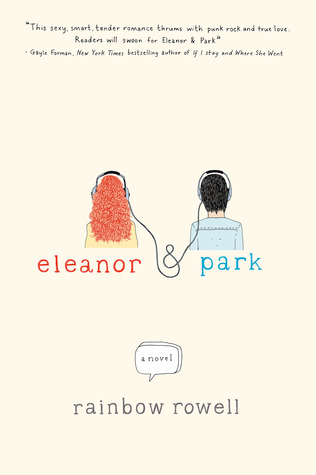
Eleanor & Park by Rainbow Rowell
I've been hearing about Rainbow Rowell all over the place for forever now, so I finally picked this one up just to see what all the fuss was about. Plus, I'm a sucker for a good romance and a nice light YA read. But this? Not my thing so much. So yes, I will credit Rowell for quality writing, really great characters, and attention to detail. But otherwise, this book contained too much of the "realistic" stuff I don't care for in contemporary YA lit. I think there is a way to write about the real issues facing teens today without straying into trashy territory, but unfortunately, this one crossed into trash a little too much for my taste. This is not to say I won't ever read Rowell again, but it's not going to be high on my priority list.
On Becoming Baby Wise: Giving Your Infant the Gift of Nighttime Sleep by Gary Ezzo
Yay for controversial parenting books! I did not read this one with my first baby, but heard plenty about it on various mommy-blogs, so when I saw it on the SALE shelf at my local library (more on that little gem later) for a mere 25 cents, I couldn't resist picking it up. I'm thinking about doing a whole post about the various parenting/sleep/baby books I've read and what my (humble and personal) opinion is about all this stuff, so I'll spare you my opinions now.
The Secret Keeper by Kate Morton
Several of my favorite book bloggers have written about Kate Morton before, so she's been on my to-read list for a while, and I finally got around to this one. In general, I loved it. I thought the writing was smooth and the characters were lovely, but by and far Morton's strongest point was how she structured the plot. It was fascinating, watching the mystery slowly unravel while jumping back and forth between present and past story lines. I was sure I had the whole thing figured out at one point, but then she threw in one final twist that I was not anticipating but that really satisfied everything that previously bothered me about the story. This is not necessarily a deep or profound story, a novel that will stay with me, or even one I highly recommend, but I enjoyed it immensely and will definitely seek out more Kate Morton in the future.
Well, in my Texas neck of the woods, where it's still 90+ sweltering degrees on the daily and no one in this house is changing routines or going back to school or anything (oh yeah, did I mention that I'm taking a leave of absence this semester? You know, with the baby coming in a month, I thought I'd give myself a break from school), it still feels like summer to me. Thus is the life of a stay-at-home-mom in Houston. Eternal summer. That may sound glorious, but when all outside activities involve gallons of sweat and man-eating mosquitoes, it's really quite miserable. Worst season ever, actually. I miss fall in Chicago like no other this time of year.
All of that intro was just to say I feel very justified in pursuing my summer reading wishlist right on in to September. I'm quite proud of the fact that even though I've only finished half of them (and the list was six books long, so maybe I shouldn't be proud at all), I've at least started all of them. That's something, right? So I will keep on reading those books no matter what the calender says about it (I mean really, there was nothing seasonally specific about my summer wishlist anyway, so it matters not at all when I actually read them).
Anyway, on to a recap of the books I read in August (where I actually did finish one of the books on that list)! I thought August was going to be a bust of a month because I started out pathetically slow on the book front (I got sick, I'm pregnant, I started potty training my two-year-old, and whatever other lame excuses I have for just being totally exhausted and unfocused all the time), but I got a little mid-month energy boost and ended up matching my June record of...
3 books!
Ugh. How on earth do I call myself a respectable book blogger? I'm still blaming everything on the pregnancy, and I hope that some time next month, when the baby is out and the hormones have settled, I'll feel somewhat normal again about my life's two greatest pleasures (that would be food first, then reading) which have both been savagely sabotaged by this pregnancy.
Anyway...
Eleanor & Park by Rainbow Rowell
I've been hearing about Rainbow Rowell all over the place for forever now, so I finally picked this one up just to see what all the fuss was about. Plus, I'm a sucker for a good romance and a nice light YA read. But this? Not my thing so much. So yes, I will credit Rowell for quality writing, really great characters, and attention to detail. But otherwise, this book contained too much of the "realistic" stuff I don't care for in contemporary YA lit. I think there is a way to write about the real issues facing teens today without straying into trashy territory, but unfortunately, this one crossed into trash a little too much for my taste. This is not to say I won't ever read Rowell again, but it's not going to be high on my priority list.
On Becoming Baby Wise: Giving Your Infant the Gift of Nighttime Sleep by Gary Ezzo
Yay for controversial parenting books! I did not read this one with my first baby, but heard plenty about it on various mommy-blogs, so when I saw it on the SALE shelf at my local library (more on that little gem later) for a mere 25 cents, I couldn't resist picking it up. I'm thinking about doing a whole post about the various parenting/sleep/baby books I've read and what my (humble and personal) opinion is about all this stuff, so I'll spare you my opinions now.
The Secret Keeper by Kate Morton
Several of my favorite book bloggers have written about Kate Morton before, so she's been on my to-read list for a while, and I finally got around to this one. In general, I loved it. I thought the writing was smooth and the characters were lovely, but by and far Morton's strongest point was how she structured the plot. It was fascinating, watching the mystery slowly unravel while jumping back and forth between present and past story lines. I was sure I had the whole thing figured out at one point, but then she threw in one final twist that I was not anticipating but that really satisfied everything that previously bothered me about the story. This is not necessarily a deep or profound story, a novel that will stay with me, or even one I highly recommend, but I enjoyed it immensely and will definitely seek out more Kate Morton in the future.
Thursday, August 28, 2014
Awesome Title
I've been thinking about titles recently. Book titles, blog post titles, that sort of thing. Titles can be very important. Titles can make a book sound unbelievably boring, or incredibly interesting. Titles can reveal everything, or conceal everything.
I'm not very good at coming up with titles, if you couldn't tell by the very title of this post.
I've always struggled with titles because, well, they are supposed to be short and creative and encapsulate the entire essence of what you've written. But the conundrum for me has always been, if I just spent so much time writing so many words to express the essence of what I want to say, whether it be a blog post or an academic paper or a novel, how do I boil that down to a mere few words in a title? So I end up with a title that is generic, obvious, or more often incoherent (the number one comment I got back from classmates who edited my last paper was that the title didn't seem to describe the paper I had written).
The ladies over at Brilliant Business Moms recently wrote a post about how to craft a killer blog post (from which I gleaned that I write very un-killer blog posts), and here's what they had to say about titles:
I realized that probably over 50% of my post titles begin with "Book Review:" Hmm, now isn't that just a thrillingly evocative hook.Research shows that many readers do not make it past the title of your post. Was your title too long or confusing? Did you hook your reader by making them curious or evoking emotion?The research says that the first 3 words and last 3 words of your title are all that your readers will see. Did you pack the most important words towards the beginning and end of your title? The beginning of your title is also more weighted for SEO, so fit your key words into the title quickly.
However, I do think I'm a bit better at coming up with titles than novelists of the 18th Century. I recently saw this list floating around facebook of actual novel titles from the 1700s, and I must say it gave me a chuckle. My particular favorite is The Adventures Of An Ostrich Feather Of Quality, followed closely by The Adventures Of An Irish Smock, Interspersed With Whimsical Anecdotes Of A Nankeen Pair Of Breeches.
I mean, are those fantastic titles, or are they fantastic titles?
And yet, somehow, I'm not inspired to read one of the books listed.
So, maybe I'm slightly better than most 18th Century authors, but still. I think I could work on coming up with better titles, in every genre I write. It's an artform, crafting titles, and one I haven't put a lot of thought into. But this is my new writing goal (manageable because it is small). I'm going to pay more attention to titles, the ones other people write and the ones I come up with on my own. I'm going to reflect more on how titles influence the way I feel about a piece of writing. I'm going to be more purposeful in how I create titles. Hopefully this will be one small way I can improve my writing overall.
Tuesday, August 19, 2014
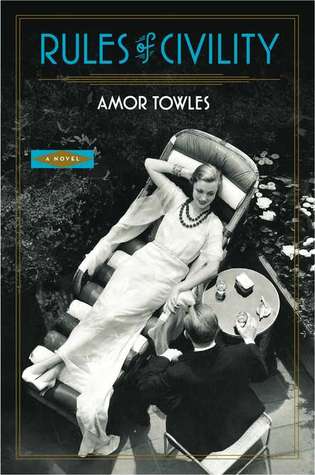
Book Review: Rules of Civility
Rules of Civility by Amor Towles
Summary (Courtesy of Goodreads): On the last night of 1937, twenty-five-year-old Katey Kontent is in a second-rate Greenwich Village jazz bar with her boardinghouse roommate stretching three dollars as far as it will go when Tinker Grey, a handsome banker with royal blue eyes and a tempered smile, happens to sit at the neighboring table. This chance encounter and its startling consequences propel Katey on a yearlong journey from a Wall Street secretarial pool toward the upper echelons of New York society and the executive suites of Condé Nast--rarefied environs where she will have little to rely upon other than a bracing wit and her own brand of cool nerve. Wooed in turn by a shy, principled multi-millionaire and an irrepressible Upper East Side ne'er-do-well, befriended by a single-minded widow who is a ahead of her time, and challenged by an imperious mentor, Katey experiences firsthand the poise secured by wealth and station and the failed aspirations that reside just below the surface. Even as she waits for circumstances to bring Tinker back into her life, she begins to realize how our most promising choices inevitably lay the groundwork for our regrets.
So I don't exactly remember where I first heard about this book, but I do remember it popped up in several places all at once the same day I was filling up my holds request list at my library, so this one was on the brain and I decided to add it to the list.
I didn't necessarily think I was going to love it. Actually, I was pretty sure I was going to hate it.
You see, this book is touted as a sort of Great Gatsby wannabe, and call me crazy, but I really dislike F. Scott Fitzgerald. I know, I know, as a former English teacher that's practically blasphemous for me to admit, but it's true. I just find his portrayal of the American dream so sad and empty and depressing. I find his characters shallow and vapid and morally reprehensible. I don't relate to those people at all.
But I do recognize that Fitzgerald was a pretty incredible writer, and I do understand why The Great Gatsby is considered a classic, so I was willing to give this one a try to see if it had any redeeming value.
And the answer is... yes and no.
I'm actually quite torn over whether I really loved this book, or hated it as much as Gatsby. It's set a decade after the roaring twenties, but even after the Great Depression there is still plenty of shallow, vapid, morally reprehensible behavior exhibited in this story of climbing the social ranks of New York. And just like the Great Gatsby, I really hated most of the characters.
But the main character? Katey, or Katherine, or Kate, or whatever people happened to call her, was someone I really related to. She was smart and level-headed, and a wonderful little introvert, and she loved Dickens! How can you not love a character who reads Dickens?
The only thing I couldn't understand about Katey was why in the world she wanted to hang out with the people she did. By and large every other character in this book (excepting maybe one or two) was completely horrible. And Tinker Grey? I mean, I kind of see why she liked him at first, but I got over him real quick, and I couldn't figure out for the life me why Katey still loved him for so long. Especially in the end, when Tinker turned out to be a bigger scumbag than even I'd anticipated, the book is still so sympathetic to him and I was just like, Why? Why does anybody like him?
So there was lots of social climbing and shallow parties and people sleeping around and all that stuff I hate about The Great Gatsby (tangent: I have such a hard time comprehending how the characters in these books can drink all the alcohol described, and not walk around completely inebriated all the time. Granted, I have zero experience with alcohol consumption, but just reading about all the drinks these people consume is enough to make me feel nauseated).
But! Then there were gems like this one (I know it's an awful long quote, feel free to skip):
I think the real test of this book for me will be time. If I'm still thinking about those little nuggets months from now, if next year this book still stands out among all the others I've read, then I think I'll be able to truly recommend it and say it's one to read. But for now, I think it's still mostly a no. If you love Gatsby, go ahead and give this one a try. You'll probably enjoy it. But otherwise, don't go rushing this to the top of your to-read list.
Summary (Courtesy of Goodreads): On the last night of 1937, twenty-five-year-old Katey Kontent is in a second-rate Greenwich Village jazz bar with her boardinghouse roommate stretching three dollars as far as it will go when Tinker Grey, a handsome banker with royal blue eyes and a tempered smile, happens to sit at the neighboring table. This chance encounter and its startling consequences propel Katey on a yearlong journey from a Wall Street secretarial pool toward the upper echelons of New York society and the executive suites of Condé Nast--rarefied environs where she will have little to rely upon other than a bracing wit and her own brand of cool nerve. Wooed in turn by a shy, principled multi-millionaire and an irrepressible Upper East Side ne'er-do-well, befriended by a single-minded widow who is a ahead of her time, and challenged by an imperious mentor, Katey experiences firsthand the poise secured by wealth and station and the failed aspirations that reside just below the surface. Even as she waits for circumstances to bring Tinker back into her life, she begins to realize how our most promising choices inevitably lay the groundwork for our regrets.
So I don't exactly remember where I first heard about this book, but I do remember it popped up in several places all at once the same day I was filling up my holds request list at my library, so this one was on the brain and I decided to add it to the list.
I didn't necessarily think I was going to love it. Actually, I was pretty sure I was going to hate it.
You see, this book is touted as a sort of Great Gatsby wannabe, and call me crazy, but I really dislike F. Scott Fitzgerald. I know, I know, as a former English teacher that's practically blasphemous for me to admit, but it's true. I just find his portrayal of the American dream so sad and empty and depressing. I find his characters shallow and vapid and morally reprehensible. I don't relate to those people at all.
But I do recognize that Fitzgerald was a pretty incredible writer, and I do understand why The Great Gatsby is considered a classic, so I was willing to give this one a try to see if it had any redeeming value.
And the answer is... yes and no.
I'm actually quite torn over whether I really loved this book, or hated it as much as Gatsby. It's set a decade after the roaring twenties, but even after the Great Depression there is still plenty of shallow, vapid, morally reprehensible behavior exhibited in this story of climbing the social ranks of New York. And just like the Great Gatsby, I really hated most of the characters.
But the main character? Katey, or Katherine, or Kate, or whatever people happened to call her, was someone I really related to. She was smart and level-headed, and a wonderful little introvert, and she loved Dickens! How can you not love a character who reads Dickens?
The only thing I couldn't understand about Katey was why in the world she wanted to hang out with the people she did. By and large every other character in this book (excepting maybe one or two) was completely horrible. And Tinker Grey? I mean, I kind of see why she liked him at first, but I got over him real quick, and I couldn't figure out for the life me why Katey still loved him for so long. Especially in the end, when Tinker turned out to be a bigger scumbag than even I'd anticipated, the book is still so sympathetic to him and I was just like, Why? Why does anybody like him?
So there was lots of social climbing and shallow parties and people sleeping around and all that stuff I hate about The Great Gatsby (tangent: I have such a hard time comprehending how the characters in these books can drink all the alcohol described, and not walk around completely inebriated all the time. Granted, I have zero experience with alcohol consumption, but just reading about all the drinks these people consume is enough to make me feel nauseated).
But! Then there were gems like this one (I know it's an awful long quote, feel free to skip):
There were several passages like this that just made me stop and think, Wow, that was actually profound. And I loved this book for those nuggets of profound wisdom.One night near the end, as I was sitting at [my father's] bedside trying to entertain him with an anecdote about some nincompoop with whom I worked, out of the blue he shared a reflection which seemed such a non sequitur that I attributed it to delirium. Whatever setbacks he had faced in his life, he said, however daunting or dispiriting the unfolding of events, he always knew that he would make it through, as long as when he woke in the morning he was looking forward to his first cup coffee. Only decades later would I realize that he had been giving me a piece of advice.Uncompromising purpose and the search for eternal truth have an unquestionable sex appeal for the young and high-minded: but when a person loses the ability to take pleasure in the mundane—in the cigarette on the stoop or the gingersnap in the bath—she has probably put herself in unnecessary danger. What my father was trying to tell me, as he neared the conclusion of his course, was that this risk should not be treated lightly: One must be prepared to fight for one’s simple pleasure and to defend them against elegance and erudition and all manner of glamorous enticements.In retrospect, my cup of coffee has been the works of Charles Dickens. Admittedly, there’s something a little annoying about all those plucky under privileged kids and the aptly named agents of villainy. But I’ve come to realize that however blue my circumstances, if after finishing a chapter of a Dickens novel I feel a miss-my-stop-on-the-train sort of compulsion to read on, then everything is probably going to be just fine.
I think the real test of this book for me will be time. If I'm still thinking about those little nuggets months from now, if next year this book still stands out among all the others I've read, then I think I'll be able to truly recommend it and say it's one to read. But for now, I think it's still mostly a no. If you love Gatsby, go ahead and give this one a try. You'll probably enjoy it. But otherwise, don't go rushing this to the top of your to-read list.
Wednesday, August 13, 2014
Books I Read in July
When I started this blog, my goal was to write a review for every book I read. I mean, honestly, I rarely read more than a book a week, so how hard can that be?
But, with all my blogging, um, laziness recently, I keep falling behind on reviews. And the further and further I get away from reading some books, the more and more I realize that I don't actually care about writing a long, in-depth review for every book I've read. Of course, for the really good books, or the reads that I have a lot to say about, I still intend to do full reviews. But for the others (for now, until my blogging steam picks up again), I think I'll stick to these simpler end-of-month round-ups.
Also, I love how we're almost half-way through August and I'm only now writing about July books. I am just coming to accept the fact that this pregnancy is going to continue kicking my trash until the bitter end, and I will never be on top of my game.
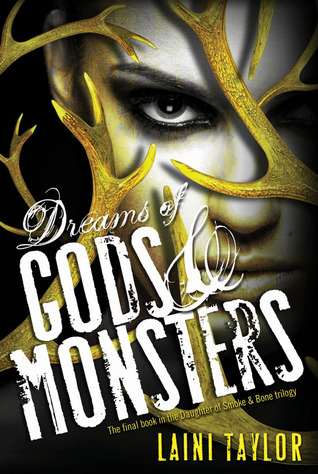
Dreams of Gods & Monsters by Laini Taylor
I've enjoyed this series since the beginning. Despite a few risque moments that mean I would never actually recommend this series to a teenager, I actually think it was quite well-written. If you enjoy solid fantasy/dystopian-ish YA trilogies, this is a good one. However, I don't think this is one that will particularly stay with me. It was just nice escapist fiction to lose myself in for a while.
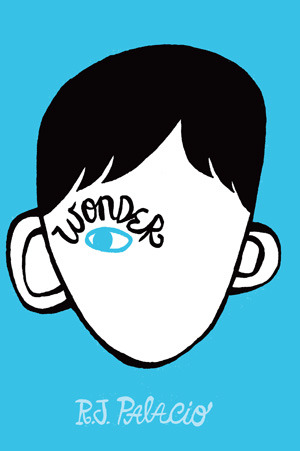
Wonder by R.J. Palacio
I read this one for my virtual book-club, and can I just say how much I LOVED it? This is quite sincerely the best middle-grade novel I think I've ever read. Yes, at times is was perhaps a bit sappy or overly sentimental, but what great middle-grade novel isn't a little heavy on sap sometimes? This one was just well written, the characters were amazingly crafted, and of course I cried through the end of it (though I AM pregnant, so I cry at everything). If you care about middle-grade fiction at all, this one is a must read.
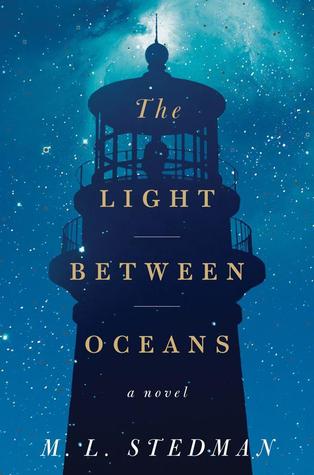
The Light Between Oceans by M.L. Stedman.
Okay, technically I only finished this one in July (I started it in February, or something ridiculous like that). But, I actually wrote a full review here. It was that good.
Rules of Civility by Amor Towles
Ah, I had such a love/hate relationship with this one. So many thoughts. In fact, I think I will do a full review on this one, because my feelings are too complicated to explain in a blurb. But you'll have to wait till next week, because how could I possibly write two posts in one week?
So, four books! Yay for July being a fairly successful reading month (better than June at least). August is not looking like it will not be quite as successful, but there are still over two weeks left, so I'm not writing this month off yet.
But, with all my blogging, um, laziness recently, I keep falling behind on reviews. And the further and further I get away from reading some books, the more and more I realize that I don't actually care about writing a long, in-depth review for every book I've read. Of course, for the really good books, or the reads that I have a lot to say about, I still intend to do full reviews. But for the others (for now, until my blogging steam picks up again), I think I'll stick to these simpler end-of-month round-ups.
Also, I love how we're almost half-way through August and I'm only now writing about July books. I am just coming to accept the fact that this pregnancy is going to continue kicking my trash until the bitter end, and I will never be on top of my game.
Dreams of Gods & Monsters by Laini Taylor
I've enjoyed this series since the beginning. Despite a few risque moments that mean I would never actually recommend this series to a teenager, I actually think it was quite well-written. If you enjoy solid fantasy/dystopian-ish YA trilogies, this is a good one. However, I don't think this is one that will particularly stay with me. It was just nice escapist fiction to lose myself in for a while.
Wonder by R.J. Palacio
I read this one for my virtual book-club, and can I just say how much I LOVED it? This is quite sincerely the best middle-grade novel I think I've ever read. Yes, at times is was perhaps a bit sappy or overly sentimental, but what great middle-grade novel isn't a little heavy on sap sometimes? This one was just well written, the characters were amazingly crafted, and of course I cried through the end of it (though I AM pregnant, so I cry at everything). If you care about middle-grade fiction at all, this one is a must read.
The Light Between Oceans by M.L. Stedman.
Okay, technically I only finished this one in July (I started it in February, or something ridiculous like that). But, I actually wrote a full review here. It was that good.
Rules of Civility by Amor Towles
Ah, I had such a love/hate relationship with this one. So many thoughts. In fact, I think I will do a full review on this one, because my feelings are too complicated to explain in a blurb. But you'll have to wait till next week, because how could I possibly write two posts in one week?
So, four books! Yay for July being a fairly successful reading month (better than June at least). August is not looking like it will not be quite as successful, but there are still over two weeks left, so I'm not writing this month off yet.
Tuesday, August 5, 2014
Theory of Mind (or, Why Readers are Better at Relationships)
I stumbled across this article last week, called "Why Readers, Scientifically, are the Best People to Fall In Love With."
Now, in my little corner of the world, this is common sense type knowledge. Of course readers are the best people to fall in love with, because, generally speaking, readers are the best type of people all around. I remember my husband, back when we were "just friends" before we were "officially dating," suggested over a Christmas break that I recommend my favorite book for him to read during the two weeks we would spend apart, and he'd recommend his favorite book for me to read. Guys, if I hadn't been smitten already, that suggestion right there was a deal sealer. I recommended Tess of the d'Urbervilles, which at the time really was my favorite, and he recommended a book I had never heard of before, The Solitaire Mystery. He confessed he was a little bit ashamed when he realized my favorite book was a renowned literary classic and his was a little-known YA novel, but that was a fact I didn't care about all (because I always love me a good YA book, and The Solitaire Mystery was absolutely delightful, and philosophical and deep in it's own way). The most impressive thing to me was that he actually read Tess, and liked it. We even had a little mini book-club-type discussion about the books when we got back after the break, and the whole time I was sort of like, "This guy was not only willing to read a classic, but he can talk to me about it intelligently!" After that, I think marriage was kind of inevitable.
But anyway, what intrigued me about the article above was the "scientific" part of it. The two studies linked to in the article aren't actually about whether readers make better romantic partners, but they did analyze the social skills (or more specifically, the empathy levels) of people who read fiction. And the results are very interesting. Apparently these studies prove that people who read fiction, and are able to immerse themselves in the comprehension of other characters and worlds, are better able than non-fiction readers to transfer those comprehension skills to real-life relationships. In other words, readers who are good at relating to the emotions of fictional characters are also good at relating to the emotions of real people.
The theoretical concept behind all of this is called "Theory of Mind," and here's where I'm going to get a bit technical, but I find this stuff interesting, so please excuse my enthusiasm. I first learned about "Theory of Mind" when reading On the Origin of Stories for my History of Narrative class this past semester. Now, I'm not actually a psychologist or whatever, but basically "Theory of Mind" is the special ability most humans develop around the age of four or five to understand that other people have a different frame of knowledge and belief than their own self. The experiment they do to see if a child has developed "Theory of Mind" goes like this: a young child watches through a window as Subject 1 hides a ball inside a box, then leaves the room. Then Subject 2 comes into the room, moves the ball from the box to another hiding spot, and leaves the room. Then Subject 1 comes back in, and they ask the child where Subject 1 believes the ball to be. Younger children, who watched Subject 2 hide the ball in a new place, will generally answer with the current location of the ball. However, sometime around the age of five, many kids will begin to understand that Subject 1 doesn't know the ball has been moved, and therefore still believes the ball to be in the box. This, in it's most simple terms, is "Theory of Mind." Basically, it's the ability to understand what other people are thinking, feeling, or experiencing.
This is quite an advanced evolutionary skill that is very advantageous for animals who live in cooperative societies, and considering humans are the only known species to have acquired "Theory of Mind," it's a big part of explaining our domination over the rest of the animal kingdom. But, what's really interesting, is that apparently fictional stories help humans develop "Theory of Mind." As in, we are biologically programmed to tell (or, in the modern world, read) and enjoy fictional stories because they help us develop a crucial skill that gives our species an evolutionary advantage over the rest of the animal kingdom.
And that skill is relationships. Understanding other people. Empathy.
Pretty cool, huh?
So the next time someone derides your introverted tendency to stay home getting lost in a good book, you can rest assured that you are actually staying home to hone your social skills.
(Unfortunately, this is not true if you are staying home to read that technical non-fiction textbook. These same studies prove that non-fiction readers actually do have worse social skills. Now, I thoroughly support non-fiction reading, but I love how these studies prove that fictional stories have a legitimate, worthwhile purpose, and my decision to be an English major is actually making me a better friend and spouse and person.)
Subscribe to:
Posts (Atom)