Quantcast
Showing posts with label Link Love. Show all posts

Wednesday, January 27, 2016

Book Blab POSTPONED! (And a few links)

Hi folks. If you're here because you were wanting to watch the live feed of The Book Blab Episode 3, I'm sorry to tell you we've postponed until further notice. Apparently Amy has completely lost her voice, and since I didn't necessarily want to do all the talking for the two of us, we decided to wait until she's better. I'll let you know when we get our schedules matched up again.

However, if you no longer know what to fill up the next half-hour of your life with, here are a few links of interesting lists or bookish items to keep you company. Enjoy and happy Wednesday!


  • I am notoriously bad at being up-to-date with currently published books. I blame it on my to-read backlist and my library's waitlist for new releases, but it's truly mostly because I'm horribly uninformed and must wait for other people to tell me what new and wonderful books to read. This list, however, has got me thinking about upcoming releases and the possibility of actually reading more books in the calendar year they are published. I'm particularly intrigued by Carrie Fisher's memoir (although that title is atrocious, in my humble opinion).
  • On the note of being more on top of current books, the short list for the Tournament of Books has been released. And I was proud that I've actually read one of the books on the list (A Spool of Blue Thread, just finished it this month). I'm interested in following the Tournament as it progresses, just to get more info on these books and see which ones I think are worth reading.
  • Modern Mrs. Darcy has released a podcast, and she is now four episodes in, I think. I love the bookish chit-chat, and her ability to recommend books is a serious gift. After listening to first few episodes, my take away is that I need to read Me Before You, because apparently I'm missing out here? 
That's all I have for now. See you soon!

Friday, April 17, 2015

Link Love


Well, dear readers, 'tis the season. That awful, horrible, wonderful season of final papers. I will likely be MIA for the next few weeks as I bury myself in such obscure topics as the dream psychology of Chaucer's early poetry, and Marlowe's Tamburlaine as a figure of capitalist venturism. Also, something about the Grapes of Wrath, but I haven't actually read that yet. I really need to get on that.

It's going to be terribly dull, but I'm also a little bit excited. Papers are fun. Brutal, but fun.

I'm such a nerd.

Anyway, I thought I'd pop over here for a quick minute and drop some interesting links your way since I don't actually have brain power to write a real post right now.

-I stumbled across this gorgeous set of classics from Barnes and Noble pictured above, and after the discovery I wrote about in my last post, I'm seriously lusting after them.

-Twelve Classic Novels as Summarized by Someone Who Has Not Read Them - short read, I rather enjoyed it. Especially if you actually know anything about the novels.

-I love book clubs. I love them so very much. But this book club has been reading only one book for the past 18 years! I can't decide if this sounds horrible, or completely awesome in a very snooty kind of way. I'm leaning toward the latter. I kind of want to join.

-Another argument for why adults should never stop reading children's books. Such good stuff.

-And maybe it's just me, but I found this article completely fascinating. Usually, I'm a bit annoyed when specific technologies shows up in a book, because then I feel like it's too contemporary and will be dated very quickly. But what are authors supposed to do? Pretend like the technological revolution isn't happening (which some do)? Really interesting topic.

Just three more weeks until the semester ends, and then, if I survive, summer break! I'm oh so ready for summer. Wish me luck!

Tuesday, January 20, 2015

Podcasts and the Advent of Narrative Arc

Image Source
Podcast is such a weird word, isn't it?

I've listened to podcasts for years. My husband and I love NPR podcasts like This American Life and Radiolab (oh, and a new one they've just launched called Invisibilia; I've only listened to the first episode so far but it was fantastic).

My husband also really enjoys Planet Money and Stuff You Should Know, which I'm always willing to listen to with him. Podcasts are our preferred audio media on shorter car trips or doing Saturday morning chores together (we save audio books for the longer car rides).

I also follow a few bookish podcasts, like Books on the Nightstand, and a new-to-me one called Read-Aloud-Revival (it's fantastic, all about creating a really strong family culture of reading).

I tend to be only an occasional listener to all of these podcasts. When I have time to listen, I usually skim through recent titles and pick out the most interesting sounding one. I have never felt the need to listen to every episode of every podcast I follow.

Until recently.

In the past few months, I've started following a few new podcasts that I feel represent a subtle yet significant and exciting shift in the podcasting world. I noticed the shift first when I discovered StartUp, and felt it again when I binged listened to the entire season of Serial in two days.

If you haven't heard of either of those podcasts (and really, if you haven't heard of Serial, do you even use the internet?), here's the background. Both of those podcasts are produced by folks associated with This American Life, both premeired their first episodes on This American Life, and both contain highly produced content that follows a narrative arc.

And therein lies the shift that I've found so exciting. Most podcasts have a general theme (books, politics, economics, etc.) but each episode is separate and self-contained. You can pick any episode you want and jump in, listen out of order, skip the boring ones, it doesn't really matter. But both StartUp and Serial follow a narrative arc. You really need to start with episode one and listen to them in order to  "get" the flow of the story they're telling.

This is exciting for me because, as a literature nerd, I love narrative. I love story. And I love that these podcasts are telling a wider, bigger story that flows through each episode. Now, they don't necessarily have a strict traditional plot curve, with a rising tension and a climatic high point and a neat and tidy resolution (especially not Serial), but they are talking about these podcasts in terms of "Seasons," where one story carries through to an end point, and they will begin again with a new story for a new season.

This is bold new ground, and I love the innovation (although I don't always love the language; unfortunately podcasts don't have the same regulations as public radio, so there tends to be a bit more swearing).

Beyond the narrative arc, both these new podcasts are thought provoking on an ethical basis too, and for very different reasons. I don't want to reveal any spoilers for those of you who haven't tried them out yet, but both of these podcasts do some very different kind of reporting on real people, real life situations, and the response they have gotten from early podcasts actually influenced and changed content in later podcasts. It's such an interesting phenomenon, and I'm fascinated by it.

So, do you listen to podcasts? Have you listened to any of these, and what do you think of them? Any recommendations of your favorites for me? I'm always interested in finding new listening material for my hour-long commute to school.

Thursday, August 28, 2014

Awesome Title


I've been thinking about titles recently. Book titles, blog post titles, that sort of thing. Titles can be very important. Titles can make a book sound unbelievably boring, or incredibly interesting. Titles can reveal everything, or conceal everything.

I'm not very good at coming up with titles, if you couldn't tell by the very title of this post.

I've always struggled with titles because, well, they are supposed to be short and creative and encapsulate the entire essence of what you've written. But the conundrum for me has always been, if I just spent so much time writing so many words to express the essence of what I want to say, whether it be a blog post or an academic paper or a novel, how do I boil that down to a mere few words in a title? So I end up with a title that is generic, obvious, or more often incoherent (the number one comment I got back from classmates who edited my last paper was that the title didn't seem to describe the paper I had written).

The ladies over at Brilliant Business Moms recently wrote a post about how to craft a killer blog post (from which I gleaned that I write very un-killer blog posts), and here's what they had to say about titles:
Research shows that many readers do not make it past the title of your post.  Was your title too long or confusing?  Did you hook your reader by making them curious or evoking emotion?
The research says that the first 3 words and last 3 words of your title are all that your readers will see. Did you pack the most important words towards the beginning and end of your title? The beginning of your title is also more weighted for SEO, so fit your key words into the title quickly.
I realized that probably over 50% of my post titles begin with "Book Review:" Hmm, now isn't that just a thrillingly evocative hook.

However, I do think I'm a bit better at coming up with titles than novelists of the 18th Century. I recently saw this list floating around facebook of actual novel titles from the 1700s, and I must say it gave me a chuckle. My particular favorite is The Adventures Of An Ostrich Feather Of Quality, followed closely by The Adventures Of An Irish Smock, Interspersed With Whimsical Anecdotes Of A Nankeen Pair Of Breeches.

I mean, are those fantastic titles, or are they fantastic titles?

And yet, somehow, I'm not inspired to read one of the books listed.

So, maybe I'm slightly better than most 18th Century authors, but still. I think I could work on coming up with better titles, in every genre I write. It's an artform, crafting titles, and one I haven't put a lot of thought into. But this is my new writing goal (manageable because it is small). I'm going to pay more attention to titles, the ones other people write and the ones I come up with on my own. I'm going to reflect more on how titles influence the way I feel about a piece of writing. I'm going to be more purposeful in how I create titles. Hopefully this will be one small way I can improve my writing overall.

Tuesday, August 5, 2014

Theory of Mind (or, Why Readers are Better at Relationships)


I stumbled across this article last week, called "Why Readers, Scientifically, are the Best People to Fall In Love With."

Now, in my little corner of the world, this is common sense type knowledge. Of course readers are the best people to fall in love with, because, generally speaking, readers are the best type of people all around. I remember my husband, back when we were "just friends" before we were "officially dating," suggested over a Christmas break that I recommend my favorite book for him to read during the two weeks we would spend apart, and he'd recommend his favorite book for me to read. Guys, if I hadn't been smitten already, that suggestion right there was a deal sealer. I recommended Tess of the d'Urbervilles, which at the time really was my favorite, and he recommended a book I had never heard of before, The Solitaire Mystery. He confessed he was a little bit ashamed when he realized my favorite book was a renowned literary classic and his was a little-known YA novel, but that was a fact I didn't care about all (because I always love me a good YA book, and The Solitaire Mystery was absolutely delightful, and philosophical and deep in it's own way). The most impressive thing to me was that he actually read  Tess, and liked it. We even had a little mini book-club-type discussion about the books when we got back after the break, and the whole time I was sort of like, "This guy was not only willing to read a classic, but he can talk to me about it intelligently!" After that, I think marriage was kind of inevitable.

But anyway, what intrigued me about the article above was the "scientific" part of it. The two studies linked to in the article aren't actually about whether readers make better romantic partners, but they did analyze the social skills (or more specifically, the empathy levels) of people who read fiction. And the results are very interesting. Apparently these studies prove that people who read fiction, and are able to immerse themselves in the comprehension of other characters and worlds, are better able than non-fiction readers to transfer those comprehension skills to real-life relationships. In other words, readers who are good at relating to the emotions of fictional characters are also good at relating to the emotions of real people.

The theoretical concept behind all of this is called "Theory of Mind," and here's where I'm going to get a bit technical, but I find this stuff interesting, so please excuse my enthusiasm. I first learned about "Theory of Mind" when reading On the Origin of Stories  for my History of Narrative class this past semester. Now, I'm not actually a psychologist or whatever, but basically "Theory of Mind" is the special ability most humans develop around the age of four or five to understand that other people have a different frame of knowledge and belief than their own self. The experiment they do to see if a child has developed "Theory of Mind" goes like this: a young child watches through a window as Subject 1 hides a ball inside a box, then leaves the room. Then Subject 2 comes into the room, moves the ball from the box to another hiding spot, and leaves the room. Then Subject 1 comes back in, and they ask the child where Subject 1 believes the ball to be. Younger children, who watched Subject 2 hide the ball in a new place, will generally answer with the current location of the ball. However, sometime around the age of five, many kids will begin to understand that Subject 1 doesn't know the ball has been moved, and therefore still believes the ball to be in the box. This, in it's most simple terms, is "Theory of Mind." Basically, it's the ability to understand what other people are thinking, feeling, or experiencing.

This is quite an advanced evolutionary skill that is very advantageous for animals who live in cooperative societies, and considering humans are the only known species to have acquired "Theory of Mind," it's a big part of explaining our domination over the rest of the animal kingdom. But, what's really interesting, is that apparently fictional stories help humans develop "Theory of Mind." As in, we are biologically programmed to tell (or, in the modern world, read) and enjoy fictional stories because they help us develop a crucial skill that gives our species an evolutionary advantage over the rest of the animal kingdom.

And that skill is relationships. Understanding other people. Empathy.

Pretty cool, huh?

So the next time someone derides your introverted tendency to stay home getting lost in a good book, you can rest assured that you are actually staying home to hone your social skills.

(Unfortunately, this is not true if you are staying home to read that technical non-fiction textbook. These same studies prove that non-fiction readers actually do have worse social skills. Now, I thoroughly support non-fiction reading, but I love how these studies prove that fictional stories have a legitimate, worthwhile purpose, and my decision to be an English major is actually making me a better friend and spouse and person.)

Tuesday, June 17, 2014

A Few Bookish Tidbits

You guys, June is killing me. I mean, how are we over half way through this month? Where is my lazy summer going? (Oh yeah, I might be sleeping it away).

Anyway, here are a few bookish things from the internet I've been reading/pondering/interested in recently.

1. This article from Slate made the rounds on my Facebook feeds a couple of weeks ago, and I can't stop thinking about it because it made me so angry. Adults should be ashamed to read YA literature!? Obviously, this sad author has lost touch with her childhood, her innocence, and any sense of decency, and I feel bad for her. It's not that I love The Fault in Our Stars so much (I don't), but I will stand up unequivocally for the value of young adult and children's literature. Take, for instance, this paragraph:

Most importantly, these books consistently indulge in the kind of endings that teenagers want to see, but which adult readers ought to reject as far too simple. YA endings are uniformly satisfying, whether that satisfaction comes through weeping or cheering. These endings are emblematic of the fact that the emotional and moral ambiguity of adult fiction—of the real world—is nowhere in evidence in YA fiction. These endings are for readers who prefer things to be wrapped up neatly, our heroes married or dead or happily grasping hands, looking to the future. But wanting endings like this is no more ambitious than only wanting to read books with “likable” protagonists.
How sad! How sad indeed that adults are only allowed "emotional and moral ambiguity" and we should feel ashamed to believe that stories actually should have endings. Excuse me if I believe in happy endings.

2. This little list from NPR last week made me super happy. I can't say I remember the show Gullah Gullah Island, but Reading Rainbow? Wishbone? These were the shows that defined my childhood! There are so many books today that I can't look at without remembering that little dog costumed as the main character. Also, my husband can still sing the entire theme song to Where in the World is Carmen Sandiego. Yep, we had some quality public programming in those days.


3. You guys, I need my favorite bookish bloggers to stop posting summer reading guides, because my to-read list has exploded recently, even as my time devoted to actual reading has plummeted. It's a conundrum for sure. Nevertheless, if you find yourself looking for that next great read this summer, my two favorite guides so far have been this one by Janssen at Everyday Reading and this one by Modern Mrs. Darcy.

4. Okay, so I was totally late to the Lizzie Bennett Diaries bandwagon, but after finally stumbling across it I binge watched all 100 episodes over two days (each episode is only five to ten minutes). It was a fantastic web-video-blog (whatever the word is) adaptation of Pride and Prejudice, and I loved it, so I was delighted to discover Emma Approved last month (still late to the game, but only half-way through this time), which is obviously an adaptation of Emma. I think this new series is a bit less charming (it took me a lot of episodes to warm up to Emma), but I still highly recommend it to all those Austen-obsessed fans out there. However, they're only on episode 53 right now, so you might want to wait until all the episodes have been released and binge watch it all at once (a highly satisfying, if time consuming experience). Either way, it's a fun way to experience Austen.

Friday, September 13, 2013

Beyond Scrabble

We are game playing people around these parts. Big time. Normally, my husband leans toward strategy games, but every now and then I can convince him to play a word game with me (mostly because it's so much easier to find word games you can play with just two people, strategy games usually require more friends). Yes, of course we own Scrabble, but it's not my favorite. Here are a few of my favorite word games.

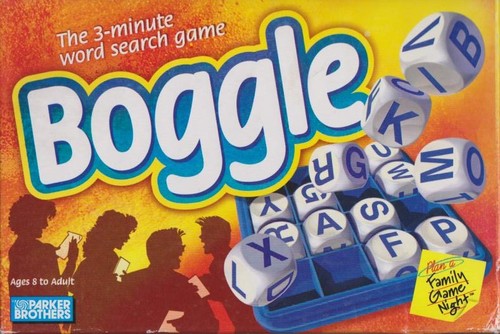
Boggle

My mom and sisters and I used to play some pretty epic Boggle matches back in the day. We played "house rules" with no timer, going for as long as we could find words (we we're always just trying to beat my younger sister, Angela, who is the best Boggle player I've ever met in my life). My husband much prefers to play by the regular rules, and I'm okay with that. Whatever it takes to get hi to play with me. This game will always be my favorite word game for all time.


Bananagrams

We were only introduced to this game a few weeks ago by some friends of ours, but I'm obsessed. It's similar to Scrabble, only you build your own board and can rearrange it however many times you need to until all your tiles are gone. It's infinitely enjoyable and frustrating at the same time. Basically, it is so much fun.


Quiddler

My husband gave me this card game a few years ago, because he knew how much I loved word games and this was one of his favorites. This game is just fun. My favorite is the crazy designs of each letter on the cards (they would not work well as flash cards for beginning readers).


Any other good word games out there we should be playing?

Friday, August 16, 2013

Other People's Writing

I've read a few articles/blog posts recently that I keep thinking about, so I thought I'd share them here.

-I've been thinking a lot recently about why I read, how I select the books I read, and being more intentional in my book choices. I'll probably write a more in depth post about some of these thoughts at some point in the future, but a few things I've heard and read recently have been contributing to these reflections. This post, by Amy over at Sunlit Pages, is one I keep coming back to about why I read. I love the reasons she lists.

-When I was in high school, I loved my English classes, but didn't care much for one of my high school English teachers. One day near Christmas break, there was an event in my seminary class (Mormon religious education-- in Utah high school students can actually have one period of "released time" to walk across the street and go to seminary) that I was supposed to dress up for. I wore a black a dress, and to accessorize a little bit for the festive holiday season, I wore a read ribbon around my neck. To my horror, this particular English teacher assumed I had dressed up as Eustacia Vye, because we were taking the final on The Return of the Native that day in my English class. I was just so embarrassed that she thought I was actually nerdy enough to dress up as a character for the test. And maybe I was that nerdy, but I didn't want her to think so. Ever since then, I've been pretty wary about character costumes, accidental or otherwise. But the more and more I embrace my inner nerdiness, the more and more I'm reconsidering this stance. This awesome post, in honor of Book Lover's Day, certainly helped. Book nerdiness never looked so stylish.

- So, if I haven't made it clear, I'm definitely a Shakespeare fan. I don't pretend to be any sort of expert or even "hardcore," but I am on the bandwagon that considers him the finest English author of all time and I admire him accordingly. The man knew how to turn a phrase. So, call me excited to learn about any additions to the Shakespeare canon. Also fun to learn that Shakespeare had terrible handwriting. So nice to know that good writing doesn't need good handwriting.

-I taught seventh grade English in my former, pre-mom life. The Hunger Games was just becoming a huge thing, and our school acquired a reading circle set. I had read the book myself, and loved it, but I was pretty wary about putting it into the hands of thirteen-year-olds. Actually, I wasn't worried about giving it to my students, I knew they would love it. I was far more worried about the reaction from parents. Luckily, I didn't get any backlash, but if I had I would have wanted an article like this to refer them to. I have enough thoughts and opinions on the topic of "disturbing" content in YA fiction  that I could write a whole series of posts about it (probably will), but as far as this kind of violence in books is concerned, I agree with this author.