Quantcast

Monday, July 15, 2013

Book Review: Chime

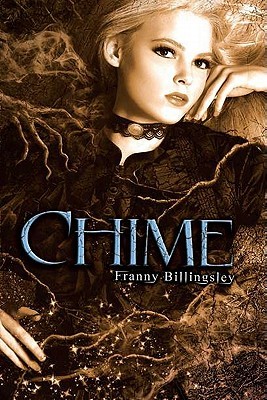
Chime by Franny Billingsley

Summary (Courtesy of Goodreads): Before Briony's stepmother died, she made sure Briony blamed herself for all the family's hardships. Now Briony has worn her guilt for so long it's become a second skin. She often escapes to the swamp, where she tells stories to the Old Ones, the spirits who haunt the marshes. But only witches can see the Old Ones, and in her village, witches are sentenced to death. Briony lives in fear her secret will be found out, even as she believes she deserves the worst kind of punishment. Then Eldric comes along with his golden lion eyes and mane of tawny hair. He's as natural as the sun, and treats her as if she's extraordinary. And everything starts to change. As many secrets as Briony has been holding, there are secrets even she doesn't know.

So when I saw the cover of this one, I was a bit wary. Usually a really pretty cover means it contains an unsubstantial story, and I know you're not supposed to judge a book by it's cover and all, but really. I tend to shy away from glamorous cover models. However, this one was recommended to me by a very reliable source (Liesl Shurtliff, actually) so I decided to withhold judgment until after reading it. And in the end, I found it to be a breath-taking, addicting, fantastic story that I didn't want to end.

I will caution, this book was disorienting at first. The narrative style is first person, but it's really unlike any other first person narration I've ever read. You get inside this girl's head, and it is very much a teenage girl's head: confused, insecure, full of undeserved self-loathing, jumbled, and barely coherent. It took me a few pages to wrap my head around this style that jumped from thought to thought with nary a segue in sight, but once I picked up on her voice, it was a totally enjoyable ride. It helped that Briony was such an interesting character in general, smart and witty (biting sarcasm) but deeply insecure and full of guilt. I'm not sure how Billingsley was able to so thoroughly capture the mind of a somewhat scarred teenager, but she did it brilliantly.

Which leads me to the other characters, and my only complaint of the book. Except for her sister (who I'll get to in a minute), every other character was disappointingly underdeveloped. This is possibly a byproduct of the strange first person narration, but I felt like I hardly got to know, much less understand, any of the other characters. Particularly Eldric. I never felt like I really had a clear picture of him or his personality. Briony's father was practically a nonentity. The other townspeople were little more than names mentioned in passing. The only character where this lack of development made sense was the step-mother, and that was on purpose for the pivotal plot twist. But, like I said, this neglect of other characters may have been on purpose, since everything is filtered through Briony's very inwardly-focused mind.

The one exception to this was Briony's sister, Rose. In modern medical terms, Rose would perhaps be labeled with some disorder on the autism spectrum, but in this time period (early 20th century) and setting (rural England) she is just a special, beautiful character whose tics and odd behaviors were simply presented and expected to be accepted. Briony's complicated relationship with Rose was also beautifully developed, with the deep love underlying the heavy sense of responsibility, guilt, and annoyance felt by Briony. It was a wonderful relationship.

Now, a word about the setting. Early 20th century England where the Old Ones are real, magic exists alongside religion and industrial technology, and witches are still hanged? I loved it! Very creative and interesting place to put this story. Even though I didn't understand everything about how the Old Ones worked, I liked the world and the magical realism elements.

And what is there to say about the plot? It is complicated, and deals with Briony working through issues relating to her step-mother's death a few months before, and trying to save the children of the village from the  swamp cough, and maybe perhaps falling in love, although that only happens to normal girls and not witch girls like Briony. I don't want to say too much more about it, because I don't want to spoil anything for anyone. I want all my friends to go out and read this one because I think (hope) they will love it as much as I did.

Yes, sure, it might be just another YA fantasy with a love triangle, but no, it's not just that. The way this character is presented, the way she thinks and feels, is so different for this genre that it makes this book stand out among the crowd. I thoroughly enjoyed the story, found it completely addicting (in a can't-put-down-this-book kind of way), and highly recommend this book to anyone who likes a good YA fantasy.

Friday, July 12, 2013

A Dream Home Library

We do not own a home. We don't even rent a home. Right now, we are in the pathetic position of crashing with my in-laws for the summer before we move into a two-bedroom apartment where we are just excited that the front door will open to the outside (as opposed to our last high-rise apartment, where the front door opened to a dimly lit interior hallway that always smelled of smoke and other questionable fumes). We likely won't own a home for several years yet (we need to dig ourselves out of some major student loan debt before we tackle mortgage debt).

But! That doesn't stop a girl from dreaming.

Yes, we have big plans for this future/hypothetical/dream home of ours. Is it some fancy kitchen? Some spacious game room? A walk-in closet just for my shoes? Nope! I have no idea what the rest of this someday house will look like, but the husband and I have definite visions for one room in particular: the library.

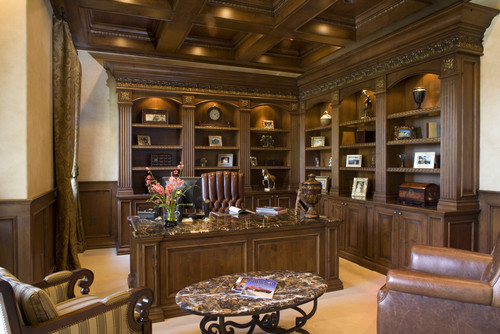
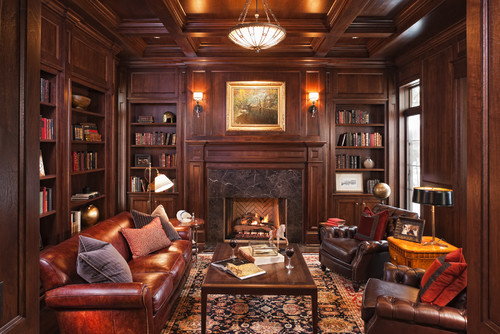
Here's the idea board:


Dark wood, I think. I don't always like dark wood, but it feels fitting in a library. Dark wood paneled walls and shelves, with a big old fireplace and a bunch of cozy chairs (may or may not be leather, I'm not sold on the leather) and little reading lamps tucked away in nooks. Sounds super cozy.


Hm, I love the idea of a cross-beamed ceiling. Makes it feel rich or something. Also, a big solid desk, necessary if this room is going to double as our home-office. Haven't decided that one yet, we'll just have to see how many rooms this dream house of ours has. But I also love the idea of a few display shelves for all of the artifacts we pick up from our (also future/theoretical/dream) world travels. A few framed maps on the walls (of the places we've been). Our large silk rug from India on the floor. A nice globe in the corner. That kind of thing.


And then, something special, just for fun. Like a spiral staircase. I mean, if this is a two-story library (which I wouldn't mind at all if it were), we're going to need a staircase. This is obviously going to be the most awesome room in the house.

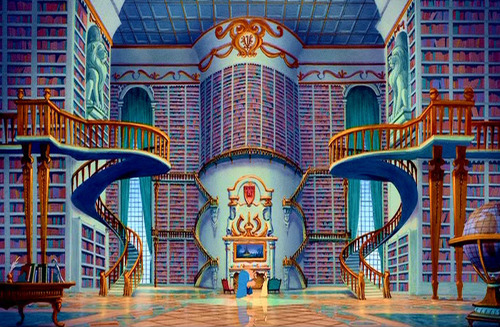
And I mean, as long as we're talking dream libraries, there's always this one:


A girl can dream...

Wednesday, July 10, 2013

A Book a Week

I was one of those nerdy kids who always had my nose stuck in a book. I had the uncanny ability to get so lost in a book that I would completely ignore everything going on around me, which really was a feat in my house (six people in a small house, it was generally crowded and noisy and hard to get away from each other). Often I would look up at the end of a chapter to find that someone had been trying to get my attention for several minutes or more. My parents used to take my books away as punishment. Cruel and unusual, if you ask me.

Anyway, when I had a really good book going and would get into my "zone," my mom used to warn me, "You won't be able to read like that when you become a mother. When you have kids, you have to pay attention to them and take care of your house and family. You can't be lost in a book all day." She offered this cautionary threat often enough that when I found myself as a new young mother (all of 18 months ago), that was the voice in my head. You can't read anymore, you need to pay attention and be responsible! You need to take care of your baby.

Here's the thing though. When you have a newborn who sleeps for eighteen hours a day and breastfeeds for approximately 90% of the rest of his waking hours, you actually have quite a bit of time on your hands for activities like reading (and crappy daytime television, but that was a short-lived affair, the stuff is just too awful). I got pretty good at balancing a nursing babe in one had and a book in the other (and also gained an entirely new appreciation for audio books). So my reading habits continued.

But so did the guilt. Because babies grow, and wean themselves, and become walking climbing terrors always getting into mischief. And then somehow having a kid means the laundry piles up and the dishes never get done and greasy hand prints show up mysteriously all over the house, and your husband starts dropping hints about the general disorder going on, and thoughts like maybe I should stop reading and start cleaning up this place start running through your head.

So anyway, last year some time I decided to make a compromise with myself. I set a goal to read one book a week, because somehow when I labeled it as a "goal" it changed from a vice to a virtue. It became something I "had" to do for this noble cause of meeting a goal. But it also set a cap on it, only one book a week. One book a week that I don't have to feel guilty about because it's working toward my noble goal (any books on top of that and I do feel guilty, it happens).

Sometimes, when I look at my to-read list, I get impatient thinking about all the books I still need to read and how am I ever going to get through them all when I only get 52 a year? But it's all about balance, this motherhood thing. And one book a week is the balance I need right now.

Monday, July 8, 2013

Book Review: The Raven Boys

The Raven Boys by Maggie Stiefvater

Summary (Courtesy of Goodreads): Every year, Blue Sargent stands next to her clairvoyant mother as the soon-to-be dead walk past. Blue herself never sees them—not until this year, when a boy emerges from the dark and speaks directly to her. His name is Gansey, and Blue soon discovers that he is a rich student at Aglionby, the local private school. Blue has a policy of staying away from Aglionby boys. Known as Raven Boys, they can only mean trouble. But Blue is drawn to Gansey, in a way she can’t entirely explain. He has it all—family money, good looks, devoted friends—but he’s looking for much more than that. He is on a quest that has encompassed three other Raven Boys: Adam, the scholarship student who resents all the privilege around him; Ronan, the fierce soul who ranges from anger to despair; and Noah, the taciturn watcher of the four, who notices many things but says very little. For as long as she can remember, Blue has been warned that she will cause her true love to die. She never thought this would be a problem. But now, as her life becomes caught up in the strange and sinister world of the Raven Boys, she’s not so sure anymore.

I was very excited for this book, mostly because I've heard so many good things about Maggie Stiefvater but hadn't read any of her books yet. Maybe I should've started with The Scorpio Races, because I'm just not sure about this one. It left me feeling very conflicted.

I'll start with what I liked about this book. It was creepy and mysterious in a good Edgar Allen Poe sort of way, and I enjoyed that. Between the graveyard scenes, the psychic fortune telling, dead bodies, ghosts, magic, and ancient Welsh folklore, there was lots of creepy ambiance that would make this a fun read around Halloween. There was also plenty of mystery and suspense. I really quite enjoyed the quest aspect of the storyline, the search for the magic lay lines and the tomb of an ancient Welsh king, and that is the storyline that I kept reading for. I wanted to find out what was going to happen with all that paranormal stuff.

I will hand it to Stiefvater, she's good at developing complex characters. Each of these characters had such different personalities, such detailed personality traits and complex backgrounds, and they came together and fit so well as a group, it was quite impressive. But this is also where the book lost me, because it felt like the back story and character development came to over run the plot. It was like this book couldn't decide if it was going to be a contemporary coming-of-age novel, or a contemporary fantasy novel. Maybe she was trying to make it be both, but I kind of wanted it to just be one or the other. There was just so much of what felt like interruption where Adam had to deal with his abusive father, or Ronan had to work out his issues with his past and/or older brother (who seemed like he was going to play a big role in the book at first, but then just disappeared half-way through the book), and while all of these issues made for some really deep character conflict, I just wanted them to get back to the paranormal stuff. Not to mention that some of the issues were just really disturbing, and would make me hesitant to recommend this book to actual young adult readers (but that's a rant for another post).

Also, the construction of the novel itself was very meandering. While I was fine with the story being told from multiple points of view, the conflict development was just not tight. Parts of the book were incredibly slow with way too much descriptive detail, and other parts were almost frantic in pace with everything happening all at once and not enough explanation. It was just a strange ride through this story, and I felt like it could've been reworked to build more steadily to a more fleshed out climax, instead of jolting and hobbling along to a rushed and inconclusive end.

Also, this is a "cycle", meaning there are four books in this series. Ugh. I don't know if I have it in me to read the next one, much as I am dying to know what happens with the magic stuff. So, in conclusion, I can see how Maggie Stiefvater is a good writer, but I'm hoping one of her other books is better.

Thursday, July 4, 2013

Where's the Revolutionary War Literature?

So, I thought it would be nice to write up a post recommending a few holiday appropriate reads for this Independence Day, but when I sat down to make a list of good, patriotic, Revolutionary War books, I drew a blank. Seriously. I can come up with roughly 100,000 WWII books, and at least half a dozen Civil War books, but the Revolutionary War? This appears to be a sadly neglected war for literary purposes. Either that, or I'm completely out of the loop.

Here's what I did come up with:

Johnny Tremain by Esther Forbes. I read this one a long, long time ago. Probably elementary school. But I still remember loving it. I'm not so hot on the details, but I have vague memories of silver smithing, Paul Revere, a little action, a little romance, and some good life lessons. Anyway, this is some great historical fiction, and I really want to reread this one again some time soon.


1776 by David McCullough. Okay, I haven't actually read this one yet, but I want to so badly. I love David McCullough. I heard him speak once, and he was just so brilliant, and thoughtful, and inspirational. You could just feel his love for our country oozing out of every corner of him, and it was so refreshing to listen to that kind of historian. This one has been on my to-read list for a while, and I just need to sit down and read it. No better time than now.


"The Declaration of Independence," by Thomas Jefferson (and a bunch of other really brilliant guys). When the literary world fails you, may as well go to the original source for some patriotic reading material. Besides, Jefferson was a pretty powerful writer. And it's not that long. I'm thinking it could be a fun tradition to read this every year around this time. Not a bad idea.


So yep, that's all I got. Anyone else know of any good Revolutionary War era books that I could look in to?

Wednesday, July 3, 2013

All The World's a Stage

Ah Shakespeare.

As any respectable English loving person should, I hold the Bard in high esteem. My Shakespeare class in college was one of the most influential and intellectually stimulating experiences of my life, and I consider him a philosophical and comedic genius.

But I must confess, I tend to like the Bard much more in short pieces, quotes, and sound bites, than in full length glory. I mean, reading through a Shakespeare play is a slog, isn't it? (Although I don't fault the Bard personally for that; it's just I have a distaste for reading scripts in general). I must confess that I have never in my life looked forward to the opportunity of sitting down to read a Shakespeare play from beginning to end.

But watching them? Oh yes, please!

As genius as Shakespeare was with words, he never meant for them to be read. They are meant to be heard, seen and experienced. Give me the chance to see a Shakespeare play, and my enthusiasm is through the roof. Combine the experience with family, good food, and zero cost? Recipe for my dream evening.

I can't remember what the festival is actually called. "Shakespeare in the Park" or "Free Will" or something like that, but my in-laws go every year. We spread out a blanket, pull out the fired chicken and potato salad, and get our dose of culture for the summer. It's a lovely time.

Forgive the blurriness. My poor camera does not do low light. And yes, this is a shot of an empty stage during intermission, because you can't actually take pictures of the performance, don't you know?

This year's play was As You Like It (thus the forest stage scene), which I had never seen nor read before. It's definitely not one of his most popular plays, and there's a reason for that. It's heavily formulaic, not incredibly imaginative, and rather cliche. But it does have the famous "all the world's a stage" speech, plus some pretty nasty hilarious insults. And I must say, the reinterpretation of the play by this company into a 60's-hippie-flower-child-forest-orgy was pretty ingenious. The image of Hymen (the God of Marriage (?), this random character that makes an appearance in the last scene) decked out in a golden loin cloth with a flower garland gyrating his hips to some psychedelic tune during the finale is an image that will probably be burned into my mind forever. I will never be able to think of anything else when I see this play again. So at least it was memorable.

Yes William, I liked it quite a bit.

Monday, July 1, 2013

Book Review: Rump

Rump: The True Story of Rumpelstiltskin by Liesl Shurtliff

Summary (Courtesy of Goodreads): In a magical kingdom where your name is your destiny, 12-year-old Rump is the butt of everyone's joke. But when he finds an old spinning wheel, his luck seems to change. Rump discovers he has a gift for spinning straw into gold. His best friend, Red Riding Hood, warns him that magic is dangerous, and she’s right. With each thread he spins, he weaves himself deeper into a curse. To break the spell, Rump must go on a perilous quest, fighting off pixies, trolls, poison apples, and a wickedly foolish queen. The odds are against him, but with courage and friendship—and a cheeky sense of humor—he just might triumph in the end.

So before starting my review, I must confess that I might be a bit biased on this one because I happen to know the author personally. Liesl is one of the dear friends we left behind in Chicago, and she is just one of those deep, thoughtful, sweet, lovely people with interesting ideas pouring out of her, so when I heard she was a published author with her first book coming out last April, I thought, "Well, that just makes sense." And of course I also thought, "How cool! I know a published author! And I own a signed copy of her book!" It's little things like that that just get me all star struck excited. So anyway, I will try to be as unbiased as possible.

First off, I love me a good fairy tale retelling (Ella Enchanted, all time favorite), but it often feels like the same fairy tales get rehashed over and over again, so it was completely refreshing to see this one was about Rumpelstiltskin, a lesser known but still fantastic fairy tale. And telling it from Rump's point of view was sheer genius (akin to the "True Story of the Three Little Pigs" told from the innocent wolf's point of view). I mean, how many male protagonists do you see in fairy tales? Especially of the non-prince variety?

Second, I thought Liesl nailed the middle-grade genre. The language is simple, descriptions are not overly-flowery, but the world is still rich with imaginative detail and the little moral messages (ideas about why some people are mean to others, what it's like to be different, and finding inner strength) are powerfully expressed. And it was funny! Of course, there are lots of jokes to be made when the main character's name is "Rump," but it was nice to see the protagonist himself poke fun at his own name. Beyond "rump" jokes, the humor in the rest of the book is subtle and clever. Also, I loved the little rhymes sprinkled throughout the story. All in all, this was a simply delightful little read.


I recommend this one in full to any middle-grade readers out there (especially the boys), their parents, or anyone who loves a good fairy-tale retelling.