We were all born and raised in a literate society, meaning that most of us, even the most illiterate of us, have been so surrounded by written words, texts, and acts of reading since we were babies that we never stop and think twice about what a strange phenomena the technology of writing actually is.
Language, for most of human history, has been a strictly oral thing. According to linguist John McWhorter, people have been speaking for at least 80,000 years, but we've only been writing for fewer than 6,000 years. And this makes sense if you think about it. Language evolved as speech, sounds coming from human throats, heard by human hears, with words invented in human brains. For most of human history, language has been located entirely within the human body, and communication could only happen with those physically close enough for the sounds produced by one body to be heard by another body.
When you stop and really think about it, it seems like quite a remarkable jump to consider the idea that sounds coming out of human mouths could be correlated to scratches of lines on clay tablets. It's not an entirely logical leap, really, this idea of writing. How did someone get the idea that a symbol on a page could represent a spoken sound?
Well, it perhaps makes a little sense, if you think in terms of pictographic writing, or writing where the symbol for a bird looks like a bird. That kind of writing makes sense as soon as humans get any sort of ideas about drawing, about visually recreating things they see in the real world. The problem is that pictographic writing is incredibly limited. How do you draw abstract words and ideas?
Well, humans solved that problem too by developing partly pictographic words, partly symbolic images for words that didn't have an image to associate with it. Thus we get hieroglyphs and other symbol based languages, but the real leap, the real incredible jump, was when someone decided that we didn't need a picture for every discreet word. Instead we could have a symbol for every sound, and thus we get the phonetic alphabet.
We are inundated with this phonetic alphabet from the time we are so little that it feels too familiar, too childish, too simple to think twice about, until you try to teach a child to read and realize, well now, yes, why exactly does the symbol "A" represent both "ah" and "a" sounds? Who decided we could give visual symbols to spoken sounds? It's quite remarkable, really, if you stop to think about it.
What spoken language is in the first place is a verbal symbol representing the thing named, but that makes phonetic writing a symbol of a symbol. It is a visual symbol of a verbal symbol, twice removed from the actual object or idea or sentiment being expressed. And yet we can see thousands of those symbols typed out here in this blog post and process these symbols of symbols with no more difficulty than if we were hearing the words spoken aloud (unless of course, you happen to have a form of dyslexia, or a brain where processing all these written symbols reveals what an actually complex task it really is; the prevelance of dyslexia just serves to prove that writing is NOT natural for every human brain, because it hasn't been around long enough for all of us to adapt to it).
In our literate society today, we love our written words. We practically drown in written words. They are not just in our books, but draped all over our signs, our machines, our walls, our food containers. We spend most of our day scrolling through written words on the tiny screens in our pockets. In many cases, we even prioritize the written word over the spoken, from the casual preference of texting over speaking on the phone, to the legal preference for a written and signed contract over a verbal promise.
But it didn't always use to be this way. Back when writing was still an infant technology and most societies still operated under the forms of oral culture, some of the world's greatest minds viewed writing with suspicion and distrust. Socrates abhorred writing, believing it would destroy our need for memory (a fair criticism) and even our ability to gain and process knowledge. He didn't understand how a man could claim to be learned if he stored all the information of his learning outside his body, and couldn't just recall facts but had to look them up in books. Ironically, we only know about Socrates' negative views on writing because his student, Plato, wrote them down, thus preserving them for future generations, but Socrates was not the only great teacher to never write his own words. Christ himself left nary an iota of written record, though we know he could both read and write (I think about this often, and often wonder why, but it's topic for a different post).
I believe there are lessons to be learned from considering this, things we have lost from the oral cultures of yesteryear that are important. We must never forget that humans evolved precisely for spoken language, with our tongues and vocal chords and our ears and our brains. Writing merely borrows from the parts of our brain designed specifically for spoken language, and I believe there are great advantages to paying attention to the importance of spoken word, and listening to spoken words.
And yet, and yet, I would not give up the technology of writing for the world.
As much as I know the human brain in general evolved for verbal language, my own particular brain has been so shaped by writing that I don't know how to function without it. I don't know what I know until I write it. I don't understand my own emotions until I write them. I have no sense of identity, of personhood, until I write my own story and figure it out. I don't know what I want to say unless I figure it out in writing first. I am at best average at speaking in the moment. At worst, I find myself tongue tied and tripping, unable to recall even simple names or facts, unable to express complex opinions. But if I go to paper (or more often now, the keyboard) and hash it out, tell the story over, sort through the complex ideas... that's when the magic happens. I come to understand. I figure life out, myself out, the world out. I learn through writing. I think through writing.
Maybe Socrates is right. Maybe I could still do all of these things if I just had to rely on speech and rhetoric and memory, if I'd been raised in an oral culture. But also, maybe there's a reason writing has taken over the world. Maybe we really can do all these things better not just because we can store our words outside our body, but because the physical and psychological process of writing actually forces our brains to think more completely or more clearly, or at the very least differently than we think when we merely speak words aloud.
Whatever it is, something about writing is magic.
And that shows up in our magic stories as well. Perhaps stories about spoken magic words are more common than stories about written magic power, but the power of language in general seems to transcend medium. Historically, spells and charms were written on scraps of paper and worn in amulets, or even ingested. Runes and symbols of magic have been carved over tombs and inscribed over doorways or gates. It's perhaps not the most common trope in magic systems, but I love it when writing is given the power to change the world. Here are two books I love that use writing as an actually magical power:
The Emperor's Soul by Brandon Sanderson
This is the one I chose to teach in the "Magic Writing" unit of my course this past semester. We actually spent part of our discussion arguing about whether what forgers do count as "writing," but in the end, most of my students agreed that, like Chinese calligraphy, it was definitely a form of writing. This one is probably still my favorite Sanderson piece, possibly because I love this magic system so much, and the power given to writing to change the physical world.
The Ten Thousand Doors of January by Alix E. Harrow
I think I loved this book simply because the magic system was exactly this: the power of writing to create reality. It can't just be said, it has to be written. I mean, it's also a fun action/adventure story with romance and new worlds and evil secret organizations trying to destroy everything, but mostly, I love it for the magic system. It's just my thing.
I know there are others out there that I haven't read (I've heard Inkheart has a bit of this kind of magic system?), but I'd love to read some more. Do you know of any books where the magic system specifically involves writing to enact power? Please share!
Showing posts with label For the Love of Words. Show all posts
Thursday, June 25, 2020
Thursday, September 27, 2018
Historical Bibliophilia
Hello! Hi there! It's been a while, as I'm once again lost in the pressures of the semester, endless amounts of reading and writing and lesson planning and grading... while still trying to maintain some semblance of normal happy life on the home front.
But I just had to steal some time tonight to stop by and tell you about this class I'm taking. Actually, both of the classes I'm taking this semester are beyond interesting and this is quite possibly the most enjoyable semester of coursework I've ever had. But one of my classes is 19th Century British Literature (we are in the middle of reading Emma, and any time Austen is homework is a fantastic time) with a theoretical emphasis on the practice and history of reading. In other words, we are studying what it means to be a book reader. What it means to be a book lover.
It's basically my favorite class ever.
While I would love to sit and rehash everything we talk about in that class here with you guys, I don't quite have the time. But talking about all things book-lover related has made me feel itchy to stop by and drop a line in this space, my book-loving space. And so, while I don't have time right now to compose anything original, I just want to share an excerpt from one of our earlier readings, just because I felt like many of you might be able to relate. This comes from an essay written by Leigh Hunt (you may or may not know him as a friend to such Romantic poets as John Keats) in 1823.
"Sitting, last winter, among my books, and walled round with all the comfort and protection which they and my fire-side could afford me; to wit, a table of high-piled books at my back, my writing-desk on one side of me, some shelves on the other, and the feeling of the warm fire at my feet; I began to consider how I loved the authors of those books: how I loved them, too, not only for the imaginative pleasures they afford me, but for their making me love the very books themselves, and delight to be in contact with them. I looked sideways at my Spenser, my Theocritus, and my Arabian Nights; then on my left side at my Chaucer, who lay on a writing-desk; and thought how natural it was in C.L. to give a kiss to an old folio, as I once saw him do to Chapman's Homer." (You can read the rest of the essay here, should you feel so inclined.)
You guys, book loving people have been around for a long time. And they truly are the best people. Feel free to go and kiss a book now.
Tuesday, November 10, 2015
Speed Reading vs. Slow Reading
![]() |
| Source |
The course was a miserable experience for me.
Have you ever taken a speed reading class? They give you metronomes and set the speed way up and tell you read an entire line within one beat and just keep your eyes moving and don't look back and never reread but just go, go, go. My comprehension plummeted, I found it incredibly frustrating, and I came away from every class with a massive headache.
Thursday, July 17, 2014
Grammar Nazi
Other areas of my life have exploded with busyness recently. It's to the point that I can't even take naps anymore (and trust me, I protect my nap times), so blogging is taking a backseat again (like it has this entire year). But anyway, I saw this music video posted on Facebook today, and couldn't help but share. It's been making the rounds, so you've probably seen it by now, but the old English teacher in me found it vastly amusing.
Somehow, I don't think the song would make much sense without the video. I can't say I'm a huge Weird Al fan, but he just nails it sometimes with his parodies. He's quite clever, really. Hats off to you, Mr. Yankovich, for providing English teachers the world over a chance to play another YouTube video in class.
Anyway, despite the fact that I am the English teacher / literature master's student / bookish person in our relationship, I will freely admit that between the two of us, my husband is by far the bigger grammar Nazi. He's a total stickler for Oxford commas and split infinitives and other rules that I consider unjustly imposed on our English language by the Latin fanatics of centuries past (because of him, I now notice all the times people misuse the subjunctive, and it's often). Maybe it's the want-to-be creative writer in me, but I'm much more kindly disposed to experimentation and focusing on communication and expression rather than mechanics and conventions.
That being said, you should know the rules before you break them. I strive to at least show I'm intelligent and aware of grammar rules (even if I don't always follow them).
What side do you fall on?
Friday, November 1, 2013
Write a Novel in a Month
I think, like every other book obsessed child out there, I always wanted to be a writer. I was that nerdy girl who wrote twelve page stories when the teacher only asked for two, kept huge notebooks filled with stories and ideas and random twaddle, and seriously planned on writing THE next great American novel. But then, writing for a career struck me as a little unstable and unpractical, so I became an English teacher, and then life happened, and that whole dream of becoming an author kind of got shelved. I always thought, Someday, when that perfect idea hits me, and I have the time, and the stars are all aligned, I'll write that Great American Novel.
But you know how things go, and I doubt I'm ever going to have that perfect idea, or the time. I have a couple of friends who have written novels (reviewed one here) and I just kind of hold them in awe. Like, wow, real people can actually think up these ideas and write these whole books and get them published!? While they do other things like raise families and go to grad school and stuff? It just seems like such a daunting thing, writing that many words!
But really, I'm going to be pretty disappointed with myself if I get to the end of this life without ever even attempting to write a book. So sometimes, you've just got to buckle down and give your life goals a try, right?
I've been skimming through Gretchen Rubin's The Happiness Project recently (got it for my birthday, one of my favorite reads) and for one of her happiness goals she writes a novel in a month. I started thinking, You know, I should just do that. Just sit down and write a novel in a month, just to try. So I'm going to, this month, try to write a novel. It just so happens (pure coincidence, I promise), that this month is November (gah! November 1st today, can you believe it?) which happens to be National Novel Writing Month. I'd heard of NaNoWriMo before, but in all honesty I hadn't paid much attention to the movement until I realized that my novel writing month was going to coincide with theirs, so I thought, what the hey! I'll sign up for an account with them. Just making this goal a little more official is all.
So yep, starting today I'm going to spend this entire month working on a novel. Do I have a plot idea? Nope. Do I have characters? Not really. Do I even know what genre of novel I want to write? No (but I'm going to figure that all out by the end of today, I promise). My only plan is to just plunge in and start writing something. It's probably going to be spectacularly horrible, and no one will ever be allowed to read it ever. But it's just something I've got to do.
So, if things are quiet around the blog this month, it's probably because I'm trying to write a book. If things are a little more busy on the blog this month, it's probably because I'll be trying to avoid writing my book (nothing like a blog post to clear up the writer's block, right?). But here's to wishing myself luck!
Now excuse me. I've got a book to write.
But you know how things go, and I doubt I'm ever going to have that perfect idea, or the time. I have a couple of friends who have written novels (reviewed one here) and I just kind of hold them in awe. Like, wow, real people can actually think up these ideas and write these whole books and get them published!? While they do other things like raise families and go to grad school and stuff? It just seems like such a daunting thing, writing that many words!
But really, I'm going to be pretty disappointed with myself if I get to the end of this life without ever even attempting to write a book. So sometimes, you've just got to buckle down and give your life goals a try, right?
![]() |
| Source |
So yep, starting today I'm going to spend this entire month working on a novel. Do I have a plot idea? Nope. Do I have characters? Not really. Do I even know what genre of novel I want to write? No (but I'm going to figure that all out by the end of today, I promise). My only plan is to just plunge in and start writing something. It's probably going to be spectacularly horrible, and no one will ever be allowed to read it ever. But it's just something I've got to do.
So, if things are quiet around the blog this month, it's probably because I'm trying to write a book. If things are a little more busy on the blog this month, it's probably because I'll be trying to avoid writing my book (nothing like a blog post to clear up the writer's block, right?). But here's to wishing myself luck!
Now excuse me. I've got a book to write.
Friday, September 13, 2013
Beyond Scrabble
We are game playing people around these parts. Big time. Normally, my husband leans toward strategy games, but every now and then I can convince him to play a word game with me (mostly because it's so much easier to find word games you can play with just two people, strategy games usually require more friends). Yes, of course we own Scrabble, but it's not my favorite. Here are a few of my favorite word games.
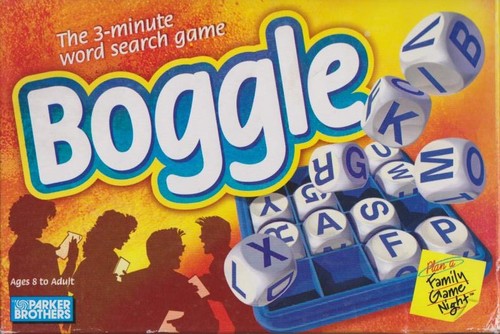
Boggle
My mom and sisters and I used to play some pretty epic Boggle matches back in the day. We played "house rules" with no timer, going for as long as we could find words (we we're always just trying to beat my younger sister, Angela, who is the best Boggle player I've ever met in my life). My husband much prefers to play by the regular rules, and I'm okay with that. Whatever it takes to get hi to play with me. This game will always be my favorite word game for all time.
Bananagrams
We were only introduced to this game a few weeks ago by some friends of ours, but I'm obsessed. It's similar to Scrabble, only you build your own board and can rearrange it however many times you need to until all your tiles are gone. It's infinitely enjoyable and frustrating at the same time. Basically, it is so much fun.
Quiddler
My husband gave me this card game a few years ago, because he knew how much I loved word games and this was one of his favorites. This game is just fun. My favorite is the crazy designs of each letter on the cards (they would not work well as flash cards for beginning readers).
Any other good word games out there we should be playing?
Subscribe to:
Posts (Atom)